You Are Not Falling Behind — You’re Opting Out
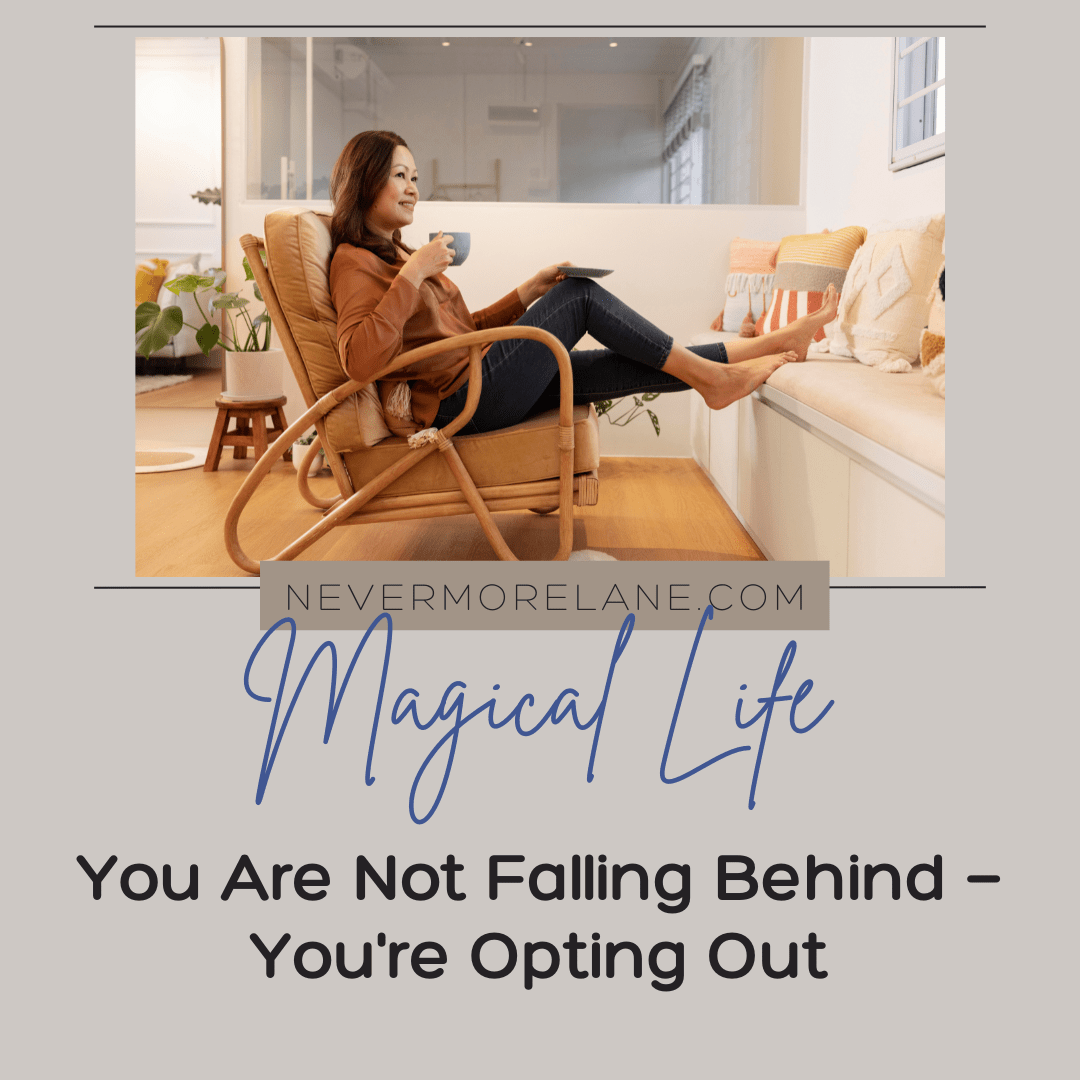
There is a particular kind of anxiety that creeps in on a quiet Sunday afternoon, when you are sitting with a book and a cup of tea and everything around you feels soft and still and good. You are not rushing. You are not producing. You are not building a funnel or optimizing a system or answering emails with the speed of someone who has something to prove. And then it hits you, that low hum of panic that whispers you should be doing more. That everyone else is hustling while you are here, unbothered, watching the light change through the window. I want to talk about that whisper today, because I think a lot of us are carrying it without even realizing how heavy it has gotten.
I have spent years in this tension myself. I run a business, I create content, I read compulsively, I keep a blog, and somehow I have also chosen to do all of it slowly, on purpose, in a way that leaves room for quiet mornings and long walks and afternoons that belong to absolutely no one but me. The world has a lot of opinions about that. Productivity culture is loud, and it is very convincing. It will tell you that your rest is laziness and your contentment is complacency and your stillness is falling behind. It is lying to you, and I think somewhere deep down you already know that.
This post is for the ones who are tired of being made to feel like their pace is a problem. Because here is the truth I keep coming back to: you are not behind. You are not failing some invisible race. You are simply choosing a different road, and that road has its own kind of magic if you let it.
Why Hustle Culture Keeps Convincing You That Rest Is a Risk
Hustle culture is not an accident. It is a carefully constructed narrative that benefits systems far more than it benefits the people inside them. When you believe your worth is tied to your output, you become an exceptionally productive member of a machine that does not particularly care about your wellbeing. That sounds bleak, but understanding the machinery is actually the first step to stepping outside it. The story that you must always be doing, growing, optimizing, and achieving is not a universal truth. It is a sales pitch, and you are allowed to stop buying it.
The fear of falling behind is deeply tied to comparison, and comparison in the digital age has become almost inescapable. You open an app and you see someone launching a course, finishing a novel, building a following, expanding a business, all before 9am on a Tuesday. What the feed does not show you is the burnout behind the scenes, the cost of that pace, or the fact that their timeline was never meant to be yours. Social media has collapsed everyone’s journey into a single, scrollable present, and it makes it nearly impossible to remember that you are watching highlight reels while living a full, complex, unedited life.
The risk that hustle culture sells you on is this: slow down and you will be left behind, forgotten, irrelevant. But the actual risk, the one nobody talks about, is spending your one life sprinting toward goals you never truly chose, arriving somewhere exhausted and wondering why it does not feel like enough. Opting out is not a risk. It is a reclamation.
What Opting Out of Hustle Culture Actually Looks Like in Real Life
Opting out does not mean doing nothing. I want to be really clear about that, because this is where the concept gets misread. Choosing a slower, more intentional life does not mean you stop working, stop creating, or stop caring about the things that matter to you. It means you stop letting urgency run the show. It means you decide what actually deserves your energy and you give it that energy thoughtfully, rather than frantically.
For me, opting out looks like not checking my phone first thing in the morning. It looks like blocking out reading time the same way I would block out a client call. It looks like taking a walk in the middle of the afternoon because my brain needs air more than it needs another hour in front of a screen. None of these things have made me less effective. If anything, they have made me more grounded, more creative, and more consistent than I ever was when I was trying to do everything as fast as possible.
For you, opting out might look completely different, and that is the whole point. It might mean leaving a group chat that makes you anxious, or taking Sundays completely offline, or simply giving yourself permission to have a hobby that produces nothing and earns no money and exists purely because it brings you joy. The shape of your opt-out is yours to decide. The important thing is that it is chosen, not defaulted into or apologized for.
How Slow Living and Intentional Rest Fuel Real Creativity
There is a reason so many of the ideas I am most proud of have come to me in the bath, or on a walk, or in the middle of a novel that had nothing to do with anything I was working on. Rest is not the opposite of creativity. It is where creativity actually lives. The brain needs unstructured time to make connections, to process, to wander. When you fill every gap with content and noise and stimulation, you are not being more productive. You are actually blocking the part of your mind that does the most interesting work.
The Romantic poets knew this. The Impressionists knew this. Anyone who has ever made something genuinely good knows that the fallow periods, the slow seasons, the quiet mornings are not wasted time. They are the compost. They are where the next thing is quietly becoming itself before you even know it needs to exist. Hustle culture has no patience for this process, which is exactly why so much hustle-culture content feels thin and interchangeable. Speed produces volume. Slowness produces depth.
If you have been feeling creatively blocked or burned out or like you are just going through the motions, I would invite you to consider that the answer is not to push harder. The answer might be to take your hands off the wheel for a little while and let your mind do what it does best when no one is demanding anything of it. Go slow. Go quiet. See what surfaces.
Releasing the Guilt That Comes With Choosing a Different Pace
The hardest part of opting out is not actually the opting out. It is the guilt that follows you around afterward. Even when you know intellectually that you are making a healthy, sustainable, intentional choice, there is a part of your brain that has been so thoroughly marinated in productivity culture that it will try to convince you that you are being irresponsible. This is normal. It does not mean you are doing anything wrong. It means you are deprogramming, and deprogramming takes time.
One thing that has helped me enormously is finding community with people who share this value, people who celebrate a slow morning the same way hustle culture celebrates a 5am wake-up, people who understand that your reading pile and your afternoon nap and your long handwritten letters are not symptoms of laziness but expressions of a deeply considered life. The slow living and cottagecore and dark academia communities exist in part because people needed somewhere to be seen in their quietness. You are not alone in this, not even a little.
Guilt also tends to loosen its grip when you get really honest with yourself about whose approval you are actually chasing. A lot of hustle anxiety is rooted in wanting to be perceived as a serious, worthy, hard-working person by people who may not even be paying that close attention. When you step back and ask whose voice is actually narrating that internal pressure, sometimes you find it does not even belong to anyone in your current life. You can gently hand it back.
Your Pace Is Not a Problem to Be Fixed
You were not built for maximum output. You were built for a life, a full, textured, peculiar, beautiful life that has room in it for wandering and wondering and doing absolutely nothing of measurable consequence on a Wednesday afternoon. The idea that you owe the world your constant productivity is a relatively recent invention and a very bad one, and you are under no obligation to keep honoring it.
Opting out is not giving up. It is getting very clear about what you actually want and refusing to trade it for the appearance of ambition. The people who seem to have it all figured out, the ones sprinting confidently toward every goal at once, are not necessarily living better than you are. They are just living louder. And loud has never been the same thing as right.
So if you have been feeling behind, I want to gently offer you this reframe: you are not behind. You are just not in that race anymore. And leaving a race you never entered willingly is not a failure. It is one of the bravest and most quietly radical things you can do.
You might also enjoy other posts here on Nevermore Lane where we talk about slow mornings, analog living, and building a life that actually feels like yours. There is always something simmering on these pages for the ones who are choosing differently.
And if you would like to sit with this a little longer, come join me for coffee. I am always here, unhurried, with something warm in hand and a lot more to talk about.
Like what you read? Drop me a line – let’s chat over virtual coffee.
~ Chrystal