How To Plan A Family Game Night That Works For Every Age
Key Takeaways
- Family game nights encourage connection, communication, and quality time through shared activities.
- Choose games based on players’ ages, interests, abilities, group size, and available time.
- Simple rule adjustments and team play can help children and adults of different ages participate.
- Different game formats provide practice with counting, vocabulary, memory, planning, and problem-solving.
- Clear expectations, gentle guidance, and breaks can reduce frustration and keep play enjoyable.
- Accessibility adjustments, such as larger pieces and extra time, help everyone take part.
- Short, flexible game sessions can become meaningful family routines without requiring expensive materials or extensive preparation.
A successful family game night is less about finding one perfect game and more about creating a low-pressure routine that helps everyone feel welcome. Whether your household includes preschoolers, teens, parents, or grandparents, the best educational games families play together are the ones that match the people at the table, the time available, and the energy in the room. Keep the goal simple: spend time together, laugh when things go wrong, and give each person a chance to participate. A short game that ends with everyone still smiling is usually a better choice than a long session that becomes stressful.
Why Family Game Nights Work
Games give families a shared activity with a clear beginning, middle, and end. Players take turns, explain choices, react to setbacks, and pay attention to one another. Those moments can open up conversation in a way that watching television together often does not. Play should not feel like a lesson or a test. Still, structured games can offer useful practice in patience, rule-following, and responding to others. Recent research on social skills and board games reported gains in social understanding among young children who used specially designed social-cognition games in preschool settings. At home, the main priority remains enjoyment and connection.
How To Choose The Right Game
Choose for the group in front of you, rather than relying only on the age printed on a box. A quick checklist can prevent a promising game from becoming frustrating.
- Age range: Younger players should be able to understand the basic goal and manage most pieces safely. Playtime: Short games work well on busy evenings, while weekends may allow more time.
- Player count: Avoid games that leave people waiting too long between turns.
- Difficulty: Pick rules that are challenging enough to be interesting but not so complicated that adults must constantly intervene.
- Play style: Rotate among cooperative, competitive, creative, word, number, and story-based games.
- Reading and movement: Consider whether players need to read cards, count accurately, sit still, or respond quickly.
Making Mixed-Age Groups Feel Included
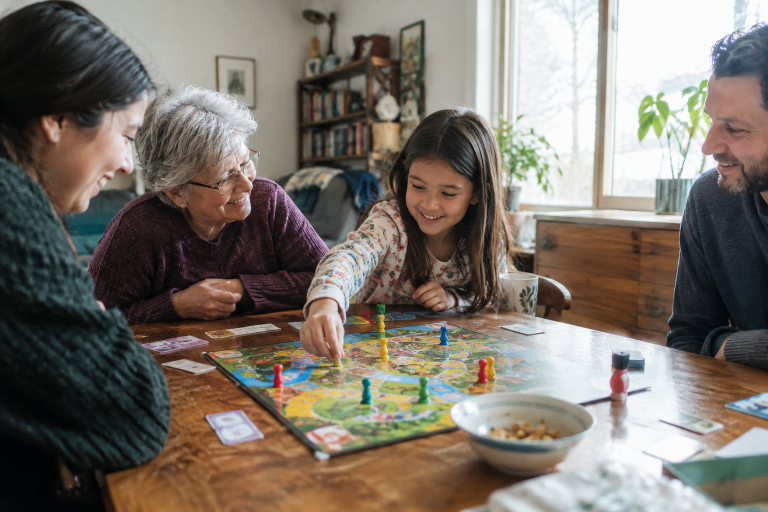
One game will not feel equally easy for every age, but small adjustments can narrow the gap. Give younger children a simple responsibility, such as rolling, counting, sorting, or choosing between two options. Ask an older child to teach one rule at a time, rather than delivering a long explanation. Team play is especially useful when abilities vary widely. Pair a confident reader with a newer reader, or let an adult and child make decisions together. Remove advanced rules during the first round, offer a practice turn before scoring begins, and allow short breaks when attention starts to fade.
A Simple Game Night Plan
- Choose a time: Set a regular evening or use a flexible weekend window.
- Prepare the space: Clear the table, gather drinks, and put away unrelated distractions.
- Offer two choices: Let the group vote between a quick option and a longer option.
- Explain the goal first: Tell everyone what they are trying to do before covering exceptions.
- Use a practice round: gently correct small mistakes and keep the game moving.
- Finish while interest is high: Stopping on a positive note makes another game night more likely.
Learning Through Play
Different game formats can give children informal practice with a range of skills. Number games may involve counting, comparing amounts, and estimating. Word games can encourage vocabulary and storytelling. Pattern games may use memory, sorting, and spatial reasoning, while strategy and team games invite planning, communication, and flexible thinking.
A 2026 University of Oregon review summarized 18 studies of linear number board games for children from preschool through second grade. Research from 2026 on number board games found evidence that these activities can support early math outcomes. Results still depend on the child, the game, the support provided, and how consistently it is used. Games can complement school learning and free play, not replace either one.
How To Reduce Frustration And Conflict
Disagreements are normal, particularly when players are tired or highly competitive. Set a few expectations before starting: losing is part of the game, teasing must stay kind, and rules do not change midway unless everyone agrees. Praise patience, clear explanations, and thoughtful choices, not only the final score. A simple reset rule can help. Any player may ask for a one-minute pause to get water, take a breath, or clarify a rule. If competition repeatedly causes tension, choose a cooperative game with a shared goal. Children should also be allowed to decline another round without being pressured.
Making Games More Accessible
Accessibility helps more people join the same activity. Use larger pieces, high-contrast materials, or a less crowded layout when visual access is difficult. Read instructions and cards aloud, allow extra time for turns, and provide both spoken and written explanations where helpful. Some players may prefer predictable steps, fewer pieces, lower noise, or more independent participation. These adjustments do not lower expectations. They remove avoidable barriers and help each participant contribute in ways that work for them.
Fresh Ideas
- Theme nights: Choose games around travel, animals, food, science, or storytelling.
- Teach-the-family night: Let one person choose and teach the game.
- Skill swap: Have each player select a game that focuses on a different type of thinking.
- Family tournament: Track points across several short games instead of one long match.
- Grandparent edition: Invite an older relative to teach a favorite game and share a memory about it.
- Screen-free mini night: Play for 20 minutes when a full evening is not realistic.
Common Questions About Family Game Nights
How Long Should A Family Game Night Last?
Start with 20 to 45 minutes. Add another round only if people are still engaged and enjoying themselves.
Should Parents Let Children Win?
Parents do not need to lose on purpose. Fair play, gentle guidance, and support for handling both wins and losses create a better experience.
Are Cooperative Games Better Than Competitive Games?
Neither style is automatically better. Cooperative games can reduce pressure, while respectful competition can give players practice making decisions and managing emotions.
What If A Child Does Not Want To Play?
Offer a choice without forcing participation. A child may prefer a puzzle, drawing activity, building challenge, or a short one-on-one game.
Final Thoughts on Game Night
Family game nights do not require expensive equipment, perfect behavior, or hours of free time to create meaningful moments together. A welcoming game, clear expectations, and a little flexibility can give family members of different ages a reason to sit together, talk, share ideas, and laugh. Choosing activities that match everyone’s interests, abilities, and attention spans can also make it easier for each person to participate. Some games encourage teamwork and communication, while others provide opportunities to practice patience, problem-solving, and healthy competition. Parents can keep the experience enjoyable by adjusting simple rules, taking breaks when needed, and focusing more on participation than winning. Ultimately, the best game is one that suits the people at the table, brings everyone closer, and leaves them willing to play again.
Photo by Pavel Danilyuk: https://www.pexels.com/photo/messy-table-with-beer-bottles-and-plastic-cups-7776084/