Window Treatments in Shelby Township, MI: Light, Privacy, and Comfort Guide
Key Takeaways
- Choose treatments based on the window’s primary function, such as privacy, glare control, darkness, insulation, or ease of operation.
- Consider the room’s use, window direction, nearby homes, and daily routine before selecting a material.
- Use light-filtering, room-darkening, or blackout options according to the level of light control needed.
- Plan for both daytime and nighttime privacy, especially on street-facing windows.
- Consider cordless or motorized operation for safety, convenience, and difficult-to-reach windows.
- Measure carefully and view samples in the actual room before placing an order.
Window treatments in Shelby Township need to do more than complement a room’s colors. They can help manage early sun, afternoon glare, nighttime privacy, and the seasonal comfort concerns that come with southeast Michigan weather. Whether you are updating one room or planning a full-home refresh, professional blinds installation in Shelby Township, MI can begin with a clear understanding of what each window needs to accomplish.
A bedroom near a busy neighborhood street may call for room-darkening coverage, while a living room overlooking mature trees may benefit from filtered daylight and a preserved view. The best choice is rarely one product used everywhere. Start with function, then choose the fabric, color, operating style, and finishing details that suit your home.
Table of Contents
- Start With the Window’s Main Job
- Choose the Right Light Control
- Plan for Privacy Day and Night
- Improve Seasonal Comfort
- Match Treatments to Each Room
- Consider Motorization, Safety, and Maintenance
- Measure Before Ordering
Start With the Window’s Main Job
Before comparing colors or patterns, identify the one problem each window should solve first. Is sunlight reflecting off a television? Does a bedroom become bright before the alarm goes off? Is a family room visible from the sidewalk after dark? These answers narrow the choices quickly.
Take notes at different times of day. Shelby Township homes with east- or west-facing windows can experience low-angle sun that reaches deeply into rooms, particularly during morning and late-afternoon hours. A window near a desk, dining table, or screen may need more adjustable control than a window in a hallway.
If bent slats, a worn tilt mechanism, or a shade that no longer raises smoothly is the main issue, searching for blinds repairs near me may be more practical than replacing every treatment in the room. Repair can be a sensible option when the existing style and fit still work well.
Choose the Right Light Control
Light control falls on a spectrum. Sheer fabrics soften daylight but offer limited coverage. Light-filtering shades reduce harshness while keeping a bright feel. Room-darkening shades block substantially more incoming light, while blackout materials are a stronger option for sleep spaces and media rooms. Even blackout fabric can allow light around the edges if the mounting style leaves side or top gaps.
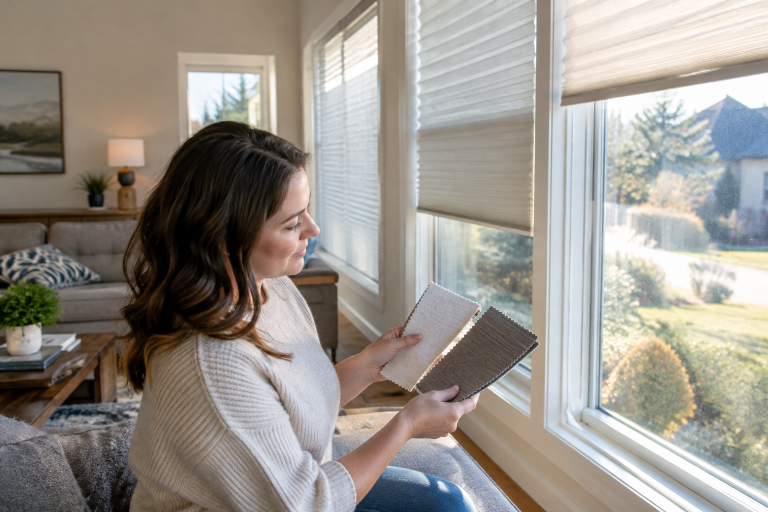
Blinds and shutters offer adjustable slats, making them useful when you want to redirect light rather than fully cover the glass. Solar shades can reduce glare while retaining some outward visibility. For rooms that need a bright daytime setting and stronger coverage after sunset, layering a shade with drapery panels provides more flexibility.
Window orientation matters because it affects the amount of glare and heat entering a room. The Department of Energy notes that east- and west-facing windows are generally more difficult to manage for glare and solar heat than north- and south-facing windows, making adjustable coverings especially valuable in those locations. Careful daylight planning can help preserve natural light without making a room uncomfortable.
Plan for Privacy Day and Night
Privacy is not the same in daylight as it is after sunset. During the day, a light-filtering fabric may obscure the interior from outside views. At night, interior lights can make silhouettes more visible through some materials. Test samples in both conditions before deciding that a fabric provides enough coverage.
Bedrooms, bathrooms, entry-facing rooms, and lower-level windows often need the most privacy planning. Top-down and bottom-up shades can be useful when you want daylight from above while covering the lower part of the window. A layered approach can also work well: use a shade for daily control and panels for added evening coverage.
Improve Seasonal Comfort
Michigan’s cold winters and warm, sunny stretches make comfort a year-round consideration. Cellular shades have air pockets that can add an insulating layer at the window. Lined drapes can provide fuller coverage, while solar shades can help reduce glare in bright rooms. These treatments support comfort, but they do not replace proper window installation, weatherstripping, or insulation.
Closing shades or curtains at night can add a layer between the room and the glass, while adjusting coverings during sunny periods gives homeowners more control over direct light. The U.S. Department of Energy recommends using window coverings to block direct sun during warm weather and help retain warmth during winter. Shades and curtains can support greater control over comfort when used as part of a broader home-efficiency plan.
Match Treatments to Each Room
Living Room
Choose light-filtering shades for a softer daytime glow, or adjustable blinds when the sun shifts across the room. Drapery panels can add texture and enhance evening privacy without requiring heavy coverage throughout the day.
Bedroom
Prioritize room-darkening or blackout materials when sleep is the goal. Check the fit around the edges, especially for windows that receive early morning light. Quiet motorization can be convenient for large bedrooms or windows behind furniture.
Kitchen and Bathroom
Select materials that are easy to wipe clean and suited to occasional moisture. Keep hanging fabrics clear of cooking surfaces, and make sure the treatment does not interfere with window handles or ventilation.
Home Office
Reduce screen glare without making the room feel closed off. Solar shades and adjustable slats are often practical because they allow fine-tuning as daylight changes.
Consider Motorization, Safety, and Maintenance
Motorization is useful for high windows, wide groups of windows, and spaces where furniture blocks easy access. It can also simplify routines by opening shades for morning light and closing them for evening privacy. Still, motorization works best when the fabric, fit, and light-control level are already right.
For homes with children or pets, cordless designs remove accessible operating cords. Also consider maintenance before choosing: smooth, wipeable materials can be convenient in busy spaces, while fabric treatments may need regular dusting or gentle vacuuming. Ask about batteries, replacement parts, and manual operation before selecting powered products.
Measure Before Ordering
Accurate measurements prevent many common frustrations. First, decide between an inside mount and an outside mount. Measure width and height in several places, check available mounting depth, and note trim, handles, locks, and nearby doors. For inside mounts, the narrowest width is often important, but product instructions should guide the final measurement.
Finally, bring samples into the room and view them in morning light, afternoon sun, and evening interior lighting. A thoughtful room-by-room plan gives Shelby Township homeowners window treatments that look intentional and make everyday living more comfortable.