Outdoor Cookware That Lasts (Plus an Easy One-Skillet Campfire Breakfast)
Outdoor Cookware That Lasts (Plus an Easy One-Skillet Campfire Breakfast)
Walk down the camping aisle of any outdoor store and you’ll see hundreds of pots and pans, each claiming to be the best. Most won’t survive a season. The ones that do fall into a few categories that experienced outdoor cooks come back to year after year.
The Real Test
Home cookware is judged on heat distribution. Outdoor cookware is judged on weight, durability, fuel compatibility, easy cleanup without a dishwasher, and packability. A pan that cooks beautifully but cracks when it hits cold water isn’t an outdoor pan.
Cast Iron: The Gold Standard
Cast iron is nearly indestructible, works on gas, butane, open flame, or coals, builds up a natural nonstick surface, and doubles as a baking dish and serving pan. The trade-offs: it’s heavy (a 10-inch skillet weighs 5+ pounds), it rusts if you neglect the seasoning, and it can crack from extreme temperature shock.
If you only own one outdoor pan, make it a 10-inch cast iron skillet.
Stainless Steel: Underrated
Quality tri-ply or five-ply stainless steel heats evenly, works on every fuel, and lasts decades. It’s best for pots: boiling, simmering, and one-pot meals. Use cast iron for searing.
Nonstick: Useful, but Short-Lived
Nonstick is best for eggs and pancakes, and it cleans up with very little water. But the coating wears out with heat and abrasion. Outdoors, expect one or two seasons. Buy mid-range, use wood or silicone utensils, and treat it as a consumable.
Aluminum: For Backpacking
Hard-anodized aluminum is light and heats well, but it dents and doesn’t hold heat. Save it for trips where weight matters most.
What to Skip
- Thin copper-bottom sets from big-box stores
- Plastic handles
- Glass lids
- Cheap “camping-branded” stainless steel with a premium price
- “Metal-utensil-safe” nonstick claims
The Four-Piece Starter Set
- A 10-inch cast iron skillet
- A 4-quart stainless steel pot with a lid
- An 8-inch nonstick pan (replace every two seasons)
- A small saucepan or kettle
That’s about 12 pounds in total, and it covers 95% of outdoor meals.
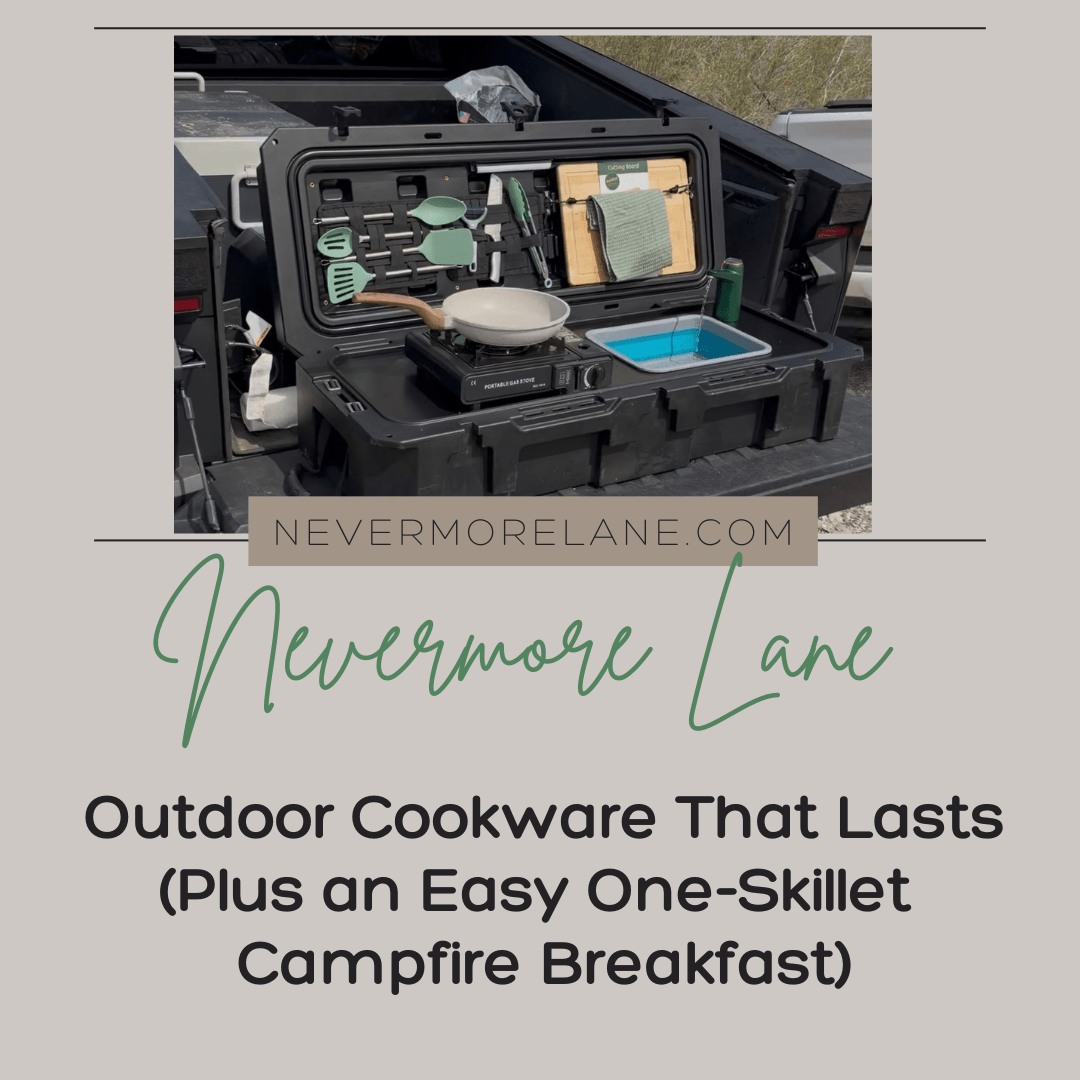
If you’d rather not research each piece, an all-in-one camp kitchen includes curated cookware sized to the stove and stored in dedicated slots in a weatherproof case, so nothing rattles around and everything is matched.
Recipe: One-Skillet Campfire Breakfast Hash
Serves 4 · 25 minutes · 10-inch cast iron skillet
Ingredients
- 2 tbsp oil or butter
- 1 lb potatoes, diced small (or 1 bag frozen diced hash browns)
- 1 small onion, diced
- 1 bell pepper, diced
- 8 oz breakfast sausage or diced ham
- 4 eggs
- Salt, pepper, paprika
- Shredded cheese and hot sauce, to serve
Steps
- Heat the oil in the skillet over medium-high. Add the potatoes in an even layer and cook for 8–10 minutes, stirring occasionally, until golden.
- Add the onion, pepper, and sausage. Cook for 5–7 minutes until the sausage is cooked through. Season with salt, pepper, and paprika.
- Make four wells in the hash and crack an egg into each. Cover with a lid or foil and cook for 4–6 minutes, until the whites are set.
- Top with cheese, let it melt, and serve from the skillet with hot sauce.
Tip: Dice the vegetables at home and pack them in a zip bag, and breakfast is ready in about 20 minutes at camp.
Care That Makes Cookware Last
- Dry everything before storing. Wet pans rust and mildew.
- Re-season cast iron with a thin layer of oil after each use.
- Avoid temperature shock. Let pans cool before washing.
Our Final Thoughts
A small set of good pieces beats a big set of mediocre ones. Build around cast iron and stainless steel, use nonstick for eggs, and save aluminum for the backcountry. Season, dry, and store your cookware properly, and it will outlast several vehicles and a few tents.