Building a Notebook Collection Without the Guilt
I have a confession: I own more notebooks than I could possibly fill in the next two years. There’s the vintage journal with the cracked leather spine that I found at an estate sale, the dot grid Leuchtturm that’s been waiting for the “right” project for two years, and at least a dozen composition books I grabbed because they were on clearance. And you know what? I’ve made peace with it. Because somewhere along the way, I realized that my notebook collection isn’t about productivity or completion rates. It’s about possibility, beauty, and the quiet magic of having exactly the right paper waiting when inspiration strikes. The truth is – I will actually end up using them all.
But here’s the thing that took me years to understand: there’s a world of difference between collecting with intention and accumulating out of anxiety. I used to feel genuinely guilty every time I brought home a new notebook. I’d promise myself I’d finish three before buying another, then break that promise within a week when I spotted a perfect purse-sized journal at the thrift store. The guilt became part of the ritual, this heavy feeling that I was doing something wrong, that I was being wasteful or indulgent or somehow failing at the simple act of using paper. I also never pay full price. Sales, coupons, and discount shops are my go-tos and a lot of them find their way to friends for gifts.
What changed wasn’t that I stopped buying notebooks. What changed was that I stopped treating my collection like a problem that needed solving. I started seeing it as a curated library of potential, a collection of tools and talismans that serve my creative life in ways that don’t always show up as filled pages. If you’ve ever felt that familiar pang of notebook guilt, if you’ve hidden purchases or justified them with promises you knew you wouldn’t keep, this is for me and you both. Let’s talk about building a collection that feels good, that aligns with our values, and that we can actually enjoy without the constant whisper of shame.
Why Notebook Guilt Exists in the First Place
The guilt around collecting notebooks is rooted in productivity culture, and that’s worth naming explicitly. We’ve been taught that objects are only valuable if they’re being used in measurable, productive ways. A notebook sitting on a shelf is seen as wasteful. A notebook filled with writing, even if it’s just grocery lists and doodles, is virtuous. This binary thinking ignores the reality of how creative tools actually work in our lives.
Notebooks aren’t just receptacles for words. They’re containers for possibility. The blank notebook on my shelf that I bought three years ago because the cover had an art nouveau moon on it? That notebook has served me. It’s been there on the days when I needed to know that the perfect journal was waiting if I wanted to start something new. It’s been visual inspiration, a reminder of beauty, a small rebellion against the idea that everything must be immediately useful. The guilt we feel isn’t about the notebooks themselves. It’s about absorbing the message that we should always be producing, always be filling, always be finishing.
There’s also the environmental angle, which is valid but often gets weaponized against us in unhelpful ways. Yes, paper production has an environmental impact. But if you’re buying notebooks at thrift stores, estate sales, and secondhand shops, you’re literally rescuing paper products from landfills. If you’re choosing quality notebooks that will last decades rather than cheap ones that fall apart, you’re making a more sustainable choice. And if you’re buying from small makers who use recycled or sustainably sourced materials, you’re supporting a different kind of economy altogether. The guilt often comes from imagining some ideal version of ourselves who only owns three perfectly used notebooks, but that version doesn’t account for the reality of creative work, which is messy and nonlinear and often requires having options.
How to Define Your Collection’s Purpose
The first step in building a collection without guilt is getting clear on what your notebooks are actually for. And here’s the radical part: “they’re beautiful and I wanted them” is a completely valid purpose. You don’t need to justify every notebook with a specific project or use case. But having some intentionality about the role your collection plays in your life makes the whole thing feel more grounded and less like you’re just accumulating stuff because you can’t help yourself.
I think about my notebooks in categories, though these are loose and overlapping. There are working notebooks, the ones I actively use for journaling, planning, morning pages, and project notes. There are archive notebooks, filled ones I keep because they contain my life’s documentation. There are aspirational notebooks, the beautiful ones waiting for the right moment or project. And there are aesthetic notebooks, the ones I bought purely because they’re gorgeous and they make me happy when I see them on my shelf. Once I named these categories, I stopped feeling guilty about the aspirational and aesthetic ones. They’re serving a purpose. They’re not failing to be working notebooks. They’re doing exactly what they’re meant to do.
Your categories might look completely different, and that’s the point. Maybe you collect vintage notebooks specifically for their covers and paper quality, treating them as art objects and historical artifacts. Maybe you’re building a rotation of different sizes and ruling styles so you always have the right format for whatever you’re working on. Maybe you buy notebooks to support independent artists and small presses, and the collection is part of your values around where money goes. When you can articulate what your collection is for, even if it’s “because they spark joy and I like having them around,” you’re operating from intention rather than impulse.
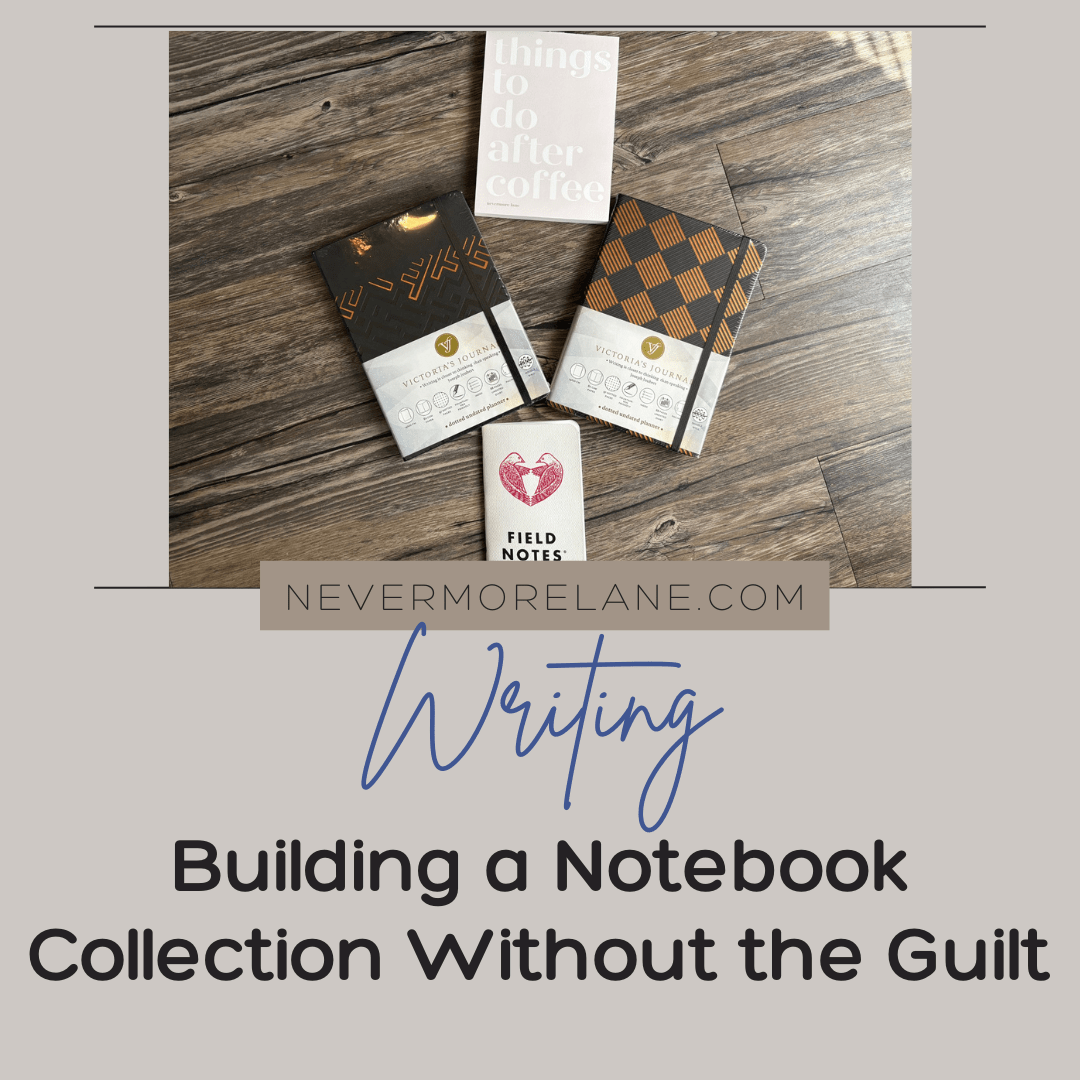
The other piece of defining purpose is being honest about what you won’t use. I don’t buy spiral bound notebooks anymore because I’ve learned I hate how they feel in my hands. The spiral gets in my way – always. I don’t buy anything smaller than A6 because tiny notebooks annoy me in practice, no matter how cute they are. Although I have discovered I can use passport style (think Field Notes) for my journaling RPG and they will fit in my Travelers Notebook. I don’t buy lined notebooks unless they’re vintage or they will be given as a gift, because I’ve accepted that I’m a dot person. These boundaries aren’t rules I’m forcing on myself. They’re observations about my actual preferences that make every future purchase more aligned with what I’ll genuinely enjoy.
Collecting Sustainably and Secondhand
If the environmental impact of your notebook collection weighs on you, the solution isn’t to stop collecting. It’s to shift how and where you collect. The secondhand market for notebooks is vast and endlessly interesting, and it aligns perfectly with the slow living values that probably drew you to Nevermore Lane in the first place. Thrift stores, estate sales, antique markets, and online secondhand platforms are full of unused vintage notebooks, old stock from closed stationery stores, and barely touched journals from people who bought them and never wrote in them.
There’s something deeply satisfying about rescuing notebooks from thrift stores. I’ve found pristine 1970s composition books with incredible cover art, unused leather journals from the 1980s, vintage memo books from long-defunct companies, and boxes of graph paper notebooks that someone’s grandmother probably used for household accounts. These notebooks were already made. The resources were already used. By buying them, I’m ensuring they get used instead of ending up in a landfill, and I’m participating in a circular economy instead of demanding new production. Plus, the hunt itself becomes part of the magic. You never know what you’re going to find.
When I do buy new notebooks (not secondhand), I’m intentional about sourcing. I look for makers who use recycled paper, sustainable forestry practices, or alternative fibers like cotton or hemp. I buy from small businesses and independent artists when possible, supporting people who care about craft and materials. I choose quality over quantity, investing in notebooks that will genuinely last rather than cheap ones that fall apart after a few months of use. And I’ve learned to recognize which new notebooks actually add something to my collection versus which ones I’m buying out of habit or because they’re on sale. The goal isn’t perfection. It’s alignment with values, which is a much more forgiving standard.
Creating a System That Feels Good
Here’s what doesn’t work (at least for me): trying to force yourself into someone else’s notebook system. I’ve tried the one-notebook method where you’re supposed to use a single journal for everything and just keep going until it’s full. I’ve tried the bullet journal system with all its migration and indexing. I’ve tried the Commonplace Book approach (although it did work for my reading, a little), the Zettelkasten method, the Morning Pages protocol. They’re all fine systems. None of them stuck for me because they weren’t built around how I actually think and work.
What works is observing your own patterns and building a system around them. I use different notebooks for different things because that’s how my brain sorts information. I have a journal for personal reflection, a separate one for dream recording, another for project planning, and a rotating selection for whatever creative work I’m doing at the moment. I don’t finish them in order. I don’t worry about gaps or wasted pages. I use them until they’re full or until they’re done, which sometimes means a notebook served its purpose with only half its pages used. And I’ve stopped feeling bad about that because the purpose of the notebook was to support the work, not to achieve 100% page utilization.
Your system might involve finishing every notebook before starting another. It might involve using the same type of notebook for everything so there’s no decision fatigue. It might involve having a specific notebook for each season, or each project, or each mood. The system that feels good is the one that reduces friction in your creative life rather than adding rules and obligations. If your current approach makes you feel stressed or guilty, it’s not the right system yet.
Part of creating a system that feels good is also being honest about the notebooks that don’t work. I have given myself permission to donate or sell notebooks that I thought I wanted but that turned out to be wrong for me in some way. The paper might be too thin, the size might be awkward, the ruling might irritate me. Keeping them out of some sense of obligation doesn’t serve anyone. Passing them on to someone who will actually love them is the better choice. Your collection should be full of notebooks that genuinely work for you, not ones you’re tolerating out of guilt.
When Collecting Becomes Curating
There’s a shift that happens when you move from anxious accumulation to intentional curation, and it changes the entire emotional texture of your collection. Curating means you’re making active choices about what comes in and what stays. It means you’re thinking about your collection as a whole, not just individual notebooks. It means you’re comfortable saying no to notebooks that don’t fit, even if they’re beautiful or on sale or recommended by someone you trust.
Curating also means creating space for your collection to breathe. I keep my current working notebooks on my desk where I can see and reach them easily. My filled notebooks live in archive boxes, organized by year. My aspirational notebooks have their own shelf, arranged by size and color because that’s what makes me happy when I look at them. The aesthetic notebooks, the vintage ones I bought for their covers, are displayed like the art objects they are. This physical organization reflects the mental organization. Everything has a place and a reason for being there.
The curation mindset also allows for evolution. Your needs change. Your aesthetic preferences shift. The notebooks that felt essential five years ago might not resonate now, and that’s fine. I’ve sold vintage notebooks I bought early in my collecting days because I realized I was keeping them out of sunk cost fallacy, not genuine love. I’ve passed on gorgeous journals to friends who I knew would appreciate them more than I did. Curating is an ongoing practice, not a one-time organization project. It’s the difference between being a collector and being someone who hoards.
Living With Your Collection Joyfully
The ultimate goal isn’t to have the perfect number of notebooks or the most organized system or the most sustainable sourcing practices. The goal is to have a collection that brings you joy without bringing you guilt. That might mean thirty notebooks or three hundred. It might mean strict categories or complete chaos. It might mean you finish every single one or you write one page in each and call them full. The measure of success is whether your collection serves your life in the ways you want it to.
I’ve learned to love my notebook collection for what it is: a reflection of my interests, my aesthetics, my optimism about future projects, and my belief that having beautiful tools matters. The notebooks I haven’t filled yet aren’t failures. They’re possibilities. The ones I bought and decided I didn’t like after all aren’t mistakes. They’re part of the learning process of understanding my own preferences. The ones I use constantly until they fall apart are doing their job. The ones that sit on my shelf looking beautiful are doing their job too.
What finally killed the guilt for me was realizing that notebook collecting is fundamentally an act of hope. Every blank notebook is a vote of confidence in your future self, a belief that you’ll have ideas worth recording and experiences worth documenting. In a world that often feels heavy and uncertain, choosing to fill your space with empty pages waiting to be written on is a small rebellion. It’s saying yes to creativity, yes to possibility, yes to the belief that what you have to say matters enough to deserve good paper.
Your Collection, Your Rules
You don’t need anyone’s permission to collect notebooks. You don’t need to justify your collection by using every page or finishing before buying more. You don’t need to feel guilty about finding joy in something as simple as paper and binding. What you need is clarity about what your collection means to you, systems that support rather than stress you, and the confidence to build something that works for your actual life instead of some imaginary ideal.
The notebooks you own are already yours. They’re not judging you for not using them fast enough. They’re not keeping score of your productivity. They’re not demanding anything from you except maybe a spot on a shelf and occasional dusting. They’re there when you need them, waiting patiently, full of potential. That’s enough. That’s always been enough.
So go ahead and buy that vintage journal at the estate sale. Pick up the beautiful handmade notebook from the local artist. Rescue the stack of composition books from the thrift store. Rescue wallets to turn them into planners and journals. Your collection doesn’t need to make sense to anyone else. It just needs to feel right to you. And if it brings you joy, if it sparks creativity, if it makes your space a little more beautiful or your inner world a little more hopeful, then it’s doing exactly what it should be doing.
Want more intentional living inspiration? Browse the blog archives for essays on slow living, analog practices, and building a life that feels like magic. And if you’re looking for me, I’m always here with coffee and conversation about the art of living with attention and wonder.
Like what you read? Drop me a line – let’s chat over virtual coffee.
~ Chrystal