The Wonders of the Night Sky: Exploring Constellations and Astronomy
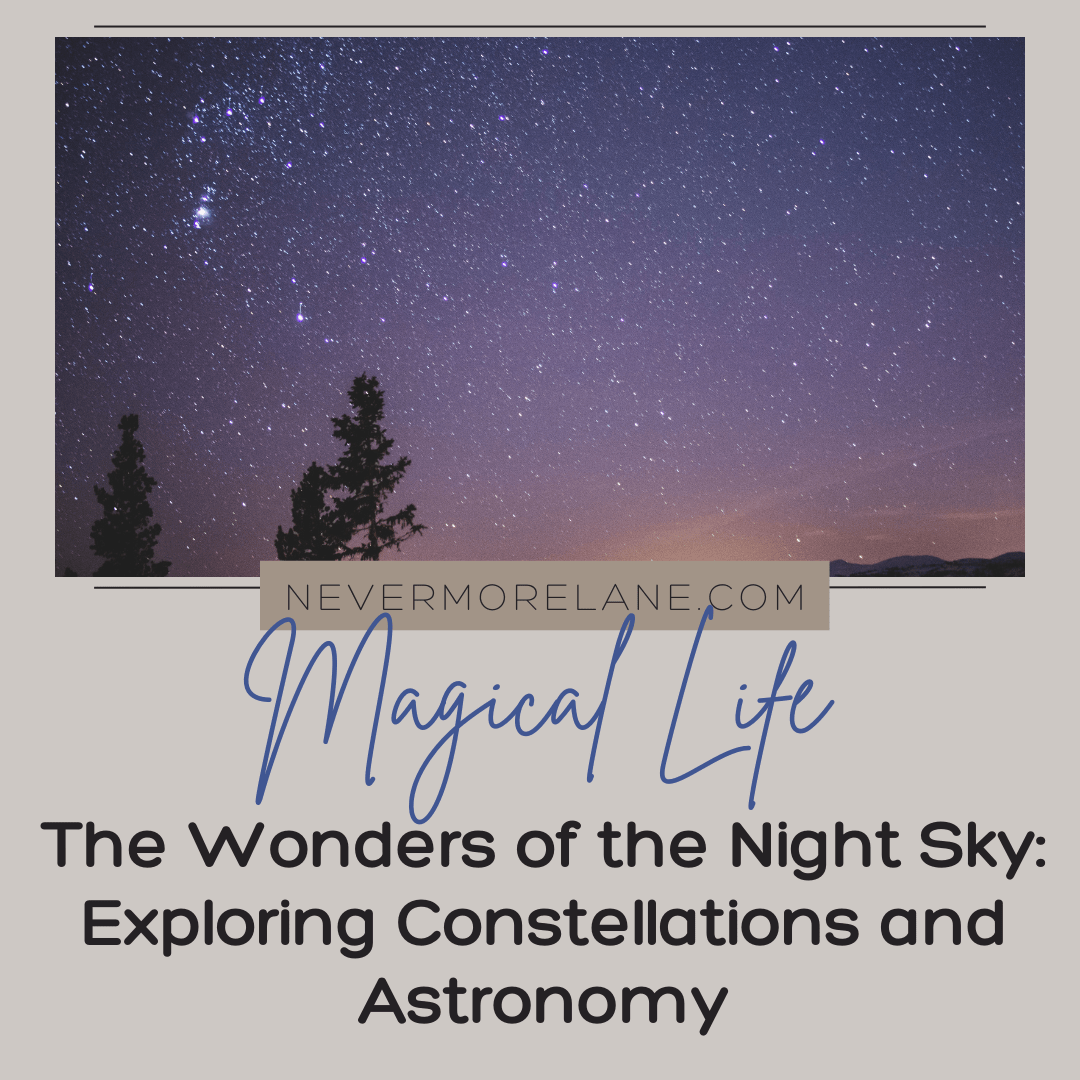
Have you ever stood beneath a star-filled sky and felt utterly small yet infinitely connected to something greater? That moment when the city lights fade away and the cosmos reveals its ancient secrets, whispering stories that have captivated humanity for thousands of years. The night sky holds a magic that transcends our daily routines, offering a gateway to wonder that costs nothing more than the willingness to look up.
A few years ago, I found myself surrounded by the mountains, miles from any streetlight. As darkness fell, the sky transformed into a glittering tapestry that took my breath away. The Milky Way stretched across the heavens like a celestial river, and for the first time in years, I could see the constellations I had learned about as a child. In that moment, I realized I had been living beneath this magnificent display every single night, yet I had forgotten to notice. The stars had been patiently waiting for me to remember their stories.
What if I told you that learning to read the night sky could become your most enchanting nightly ritual? That understanding constellations and basic astronomy could transform your evening walks into mystical journeys through time and space? Tonight, we will explore the celestial wonders above us, uncover the stories written in starlight, and discover how connecting with the cosmos can add a touch of magic to your everyday life.
Why Learning Constellations and Astronomy Matters Today
The night sky serves as humanity’s oldest storybook, its pages written in points of light that have guided travelers, inspired poets, and sparked the imagination of countless generations. Long before Netflix and smartphones captured our attention, our ancestors gathered around fires and looked up at the same stars we see today, weaving tales of gods and heroes, monsters and maidens, all dancing eternally across the celestial sphere.
Understanding the night sky begins with recognizing that what we see is both incredibly distant and intimately connected to our daily lives. The light from some stars has traveled for hundreds or thousands of years to reach our eyes, meaning we are literally looking back in time with each glance upward. Yet these same celestial bodies have influenced human culture, navigation, agriculture, and spirituality in profound ways, making them as relevant today as they were to ancient civilizations.
The beauty of stargazing lies not just in its visual splendor, but in its accessibility. Unlike many hobbies that require expensive equipment or specialized locations, astronomy asks only for clear skies and curious eyes. Whether you live in a bustling city or a quiet countryside, the major constellations remain visible, waiting to share their timeless stories with anyone willing to learn their patterns and personalities.
The Ancient Art of Constellation Reading
Constellations serve as the alphabet of the night sky, teaching us to read the stories our ancestors wrote among the stars. These stellar patterns, officially numbering 88 according to the International Astronomical Union, divide the celestial sphere into manageable sections, each with its own mythology, seasonal visibility, and navigational significance. Learning to identify even a handful of these star patterns opens up a world of wonder that transforms every clear night into an opportunity for discovery.
The most recognizable constellation in the Northern Hemisphere, Ursa Major (the Great Bear), contains the famous asterism known as the Big Dipper. This stellar ladle has served as a cosmic compass for countless generations, with its pointer stars leading directly to Polaris, the North Star. Native American traditions saw this same pattern as a great bear being hunted across the sky, while ancient Greeks told of Callisto, transformed into a bear by jealous Hera and placed among the stars by Zeus. These varying interpretations remind us that constellation stories reflect the cultures that created them, making each tradition a window into human creativity and our universal need to find meaning in the cosmos.
Seasonal constellations offer their own special magic, appearing and disappearing in predictable cycles that have marked time since civilization began. Orion dominates winter skies in the Northern Hemisphere, his belt of three bright stars unmistakable even to novice stargazers. Summer brings Cygnus the Swan flying down the Milky Way, while autumn introduces us to the great square of Pegasus and the W-shaped Cassiopeia. Learning these seasonal patterns creates a natural calendar written in starlight, connecting us to the rhythms of Earth’s journey around the Sun and the endless dance of celestial mechanics.
Celestial Navigation and Timekeeping
Before GPS satellites and atomic clocks, humans relied on the stars for navigation and timekeeping, developing sophisticated methods that remain useful and deeply satisfying today. The art of celestial navigation represents one of humanity’s greatest achievements, allowing our ancestors to cross vast oceans and traverse trackless deserts using nothing more than careful observation and mathematical insight. Understanding these techniques, even at a basic level, adds practical value to our stargazing while connecting us to the ingenuity of previous generations.
Polaris, the current North Star, sits almost directly above Earth’s North Pole, making it an invaluable reference point for navigation in the Northern Hemisphere. Finding Polaris is remarkably simple: locate the Big Dipper, identify the two stars at the end of its bowl (called the pointer stars), and follow an imaginary line through them about five times the distance between them. This technique works year-round, as the Big Dipper rotates around Polaris like a giant clock hand, changing position but always pointing toward this celestial anchor. In the Southern Hemisphere, navigators use the Southern Cross and its pointer stars to locate the South Celestial Pole, though no bright star marks this position as conveniently as Polaris does in the north.
The stars also serve as cosmic timepieces, with their positions revealing not just the time of night but the season and even the year. The concept of sidereal time, based on Earth’s rotation relative to distant stars rather than the Sun, forms the foundation of astronomical timekeeping. Ancient cultures observed that certain stars rose just before dawn at specific times of year, creating what astronomers call heliacal risings. The ancient Egyptians used the heliacal rising of Sirius to predict the annual flooding of the Nile, while farmers throughout history have used stellar calendars to determine optimal planting and harvesting times. Today, learning to estimate time by star positions adds a satisfying skill to nighttime adventures and creates a deeper appreciation for the clockwork precision of our cosmic neighborhood.
The Science Behind the Sparkle
The twinkling lights that captivate us each night represent some of the most extreme and fascinating objects in the universe, each with its own story of birth, life, and eventual death. Stars are essentially massive fusion reactors, converting hydrogen into helium and releasing tremendous amounts of energy in the process. This nuclear alchemy creates all the heavier elements necessary for planets and life itself, making us quite literally made of star stuff, as astronomer Carl Sagan famously observed.
The colors of stars reveal their temperatures and ages, creating a cosmic rainbow that tells the story of stellar evolution. Blue and white stars burn the hottest and brightest but live relatively short lives, while red stars like Betelgeuse in Orion represent either young, cool stars or ancient giants approaching the end of their stellar journey. Our own Sun, a middle-aged yellow star, represents a perfect balance of temperature and longevity, providing stable energy for billions of years. Understanding these stellar lifecycles helps us appreciate the dynamic nature of what might appear to be an unchanging sky, revealing a universe in constant flux and evolution.
The apparent twinkling of stars results not from changes in the stars themselves but from Earth’s atmosphere, which acts like a cosmic lens that bends and distorts starlight as it travels through layers of air with different temperatures and densities. This atmospheric turbulence creates the romantic shimmer we associate with starlight, though it poses challenges for professional astronomers seeking clear images. Planets, being much closer and showing as tiny disks rather than point sources, typically do not twinkle as noticeably as stars, providing one way to distinguish between these different celestial objects during casual observation.
Deep Sky Treasures Beyond the Stars
While individual stars and constellations provide the framework for celestial exploration, the night sky holds even more spectacular treasures for those who know where to look. Nebulae, star clusters, and galaxies offer glimpses into the cosmic processes that shape our universe, from stellar nurseries where new suns are born to ancient globular clusters containing some of the oldest stars in the Milky Way. These deep sky objects require patience and often binoculars or telescopes to appreciate fully, but even naked-eye observations can reveal their presence and inspire further exploration.
The Orion Nebula, visible as a fuzzy star in Orion’s sword, represents one of the most accessible stellar nurseries in our cosmic neighborhood. This vast cloud of gas and dust, located about 1,300 light-years from Earth, glows with the energy of hot young stars being born within its depths. Through binoculars, the nebula reveals intricate structure and subtle colors that speak to the dynamic processes of star formation. Similarly, the Pleiades or Seven Sisters cluster in Taurus showcases a group of hot blue stars born from the same cosmic cloud, their shared motion through space telling the story of their common origin.
Our own galaxy, the Milky Way, presents perhaps the most awe-inspiring sight available to amateur astronomers. From dark sky locations away from light pollution, this river of stars stretches across the heavens, containing billions of individual suns too distant to resolve separately. The dark lanes and bright patches within the Milky Way reveal the complex structure of our galactic home, with dust clouds silhouetted against more distant star fields and bright regions marking areas of active star formation. Observing the Milky Way connects us directly to our place in the cosmic hierarchy, reminding us that our Solar System occupies just one tiny corner of this vast stellar city.
Modern Stargazing in a Light-Polluted World
Today’s stargazers face challenges unknown to previous generations, as artificial lighting has dramatically altered our relationship with the night sky. Light pollution now affects over 80% of the world’s population, creating skyglow that washes out all but the brightest stars and completely obscures the Milky Way from most urban and suburban locations. However, this challenge has also sparked innovation and creativity among modern astronomers, leading to new techniques and technologies that make stargazing more accessible than ever before.
Urban stargazing requires strategic thinking and careful planning, but it remains surprisingly rewarding for those willing to adapt their approach. The brightest stars, planets, and major constellation patterns remain visible even from city centers, while the Moon provides spectacular viewing regardless of local light pollution. Learning to identify these prominent features creates a foundation for more advanced observations during visits to darker locations. Additionally, many cities now have astronomy clubs and public observatories that provide access to quality telescopes and expert guidance, creating communities of fellow sky enthusiasts eager to share their knowledge and passion.
Technology has become a powerful ally for modern stargazers, with smartphone apps providing real-time star charts, satellite tracking, and predictions for optimal viewing conditions. These digital tools can help identify objects in light-polluted skies and plan observing sessions around moon phases, weather patterns, and the positions of planets and deep sky objects. However, the most rewarding stargazing experiences still come from developing the ability to navigate the sky without technological assistance, using the stars themselves as guides to cosmic discovery. This balance between traditional observation skills and modern tools creates opportunities for deeper engagement with the night sky while honoring the wisdom of previous generations of astronomers.
Your Cosmic Journey Begins Tonight
The night sky offers an endless source of wonder, stories, and scientific discovery that remains as relevant today as it was thousands of years ago. Learning to read the constellations and understand basic astronomy creates a lifelong hobby that costs nothing but provides immeasurable returns in terms of perspective, peace, and connection to the universe around us. Every clear night presents an opportunity to step outside, look up, and join the ancient human tradition of finding meaning and beauty among the stars.
Starting your own stargazing journey requires nothing more than curiosity and a willingness to spend time under the open sky. Begin with the brightest constellations and most obvious patterns, gradually building your knowledge through direct observation and patient practice. The rewards multiply quickly as familiar patterns become old friends and new discoveries await around every season. Remember that the same stars that guide your explorations tonight have witnessed the entire history of human civilization, making each observing session a connection to both cosmic time and earthly heritage.
The universe above us holds infinite mysteries and endless beauty, waiting patiently for each new generation to discover its wonders. Tonight, when you step outside and look up at the stars, you become part of an unbroken chain of human curiosity that stretches back to our earliest ancestors and forward to future generations who will inherit these same celestial treasures. The magic of the night sky belongs to everyone willing to embrace its ancient call to wonder and exploration.
Where Stars Lead Us Next
The journey into astronomy and constellation study represents just the beginning of a lifelong adventure in cosmic discovery. As your comfort with the night sky grows, you might find yourself drawn to deeper studies of stellar evolution, planetary science, or the search for life beyond Earth. Perhaps you will join local astronomy clubs, attend star parties, or even contribute to citizen science projects that help professional astronomers map and understand our universe. The skills you develop in patient observation and pattern recognition serve you well in many aspects of life, while the perspective gained from regular stargazing often brings a sense of peace and wonder that enriches daily experience.
Consider keeping a stargazing journal to record your observations, track the progress of planets, and note the gradual shift of constellations through the seasons. This practice not only improves your observational skills but creates a personal record of your cosmic journey that becomes more valuable with time. Share your discoveries with friends and family, introducing others to the joy of stargazing and helping to preserve the ancient human tradition of storytelling under starlight. In our increasingly digital world, the simple act of looking up at the night sky offers a powerful antidote to information overload and a reminder of our place in the grand cosmic story.
The stars that shine down on us tonight have inspired countless generations of dreamers, explorers, scientists, and artists. They have guided ships across unknown oceans, marked the passage of seasons for farmers, and sparked the imagination of children lying on summer grass. As you begin or continue your own relationship with the night sky, remember that you become part of this ongoing story, adding your own observations and experiences to humanity’s collective understanding of the cosmos above us.
Ready to explore more magical aspects of everyday life? I would love to share more stories and discoveries with you over coffee sometime. Browse through our other posts here at Nevermore Lane to find more ways to add wonder and enchantment to your daily routine, and join our community of fellow seekers who believe that magic can be found in the most unexpected places.
Like what you read? Drop me a line – let’s chat over virtual coffee.
~ Chrystal
Photo by Sindre Fs: https://www.pexels.com/photo/silhouette-of-spruce-trees-under-starry-night-955855/