The E-Reader Research Rabbit Hole That Led Me on the Path to Digital Minimalism
How my quest for the perfect reading device became an unexpected lesson in choosing less.
Just two weeks ago, I published my commitment to going analog in 2026 – screen-free mornings, physical books, one analog day per week, and an Analog Bag (what I have always called a House Bag) filled with journals and coloring books. I wrote about reclaiming presence, about stepping away from the constant digital noise, about remembering what it feels like to engage with the world through touch and paper and real, tangible things.
Then I spent an entire week deep in the digital research trenches, comparing Android devices with app stores, Bluetooth capabilities, and HD touchscreens.
The irony wasn’t lost on me.
Here I was, committed to slower living and tactile experiences, obsessing over devices that promised to do everything. I created spreadsheets. I watched comparison videos. I joined Reddit communities debating RAM and storage and screen resolution. I had tabs open for the Boox Palma 2, the Oilsky M502, the G-mee Play Pro, OBOOK5, and the Viwoods AiPaper Reader. Each one promised to be the perfect solution, each one offering more features than the last.
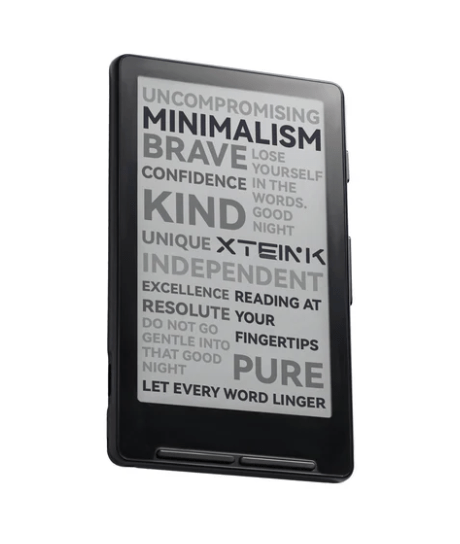
And then, in a Reddit thread at 11 PM on a Tuesday, I found the device that changed everything: the XTeink X4 – a 74-gram e-reader with no apps, no touchscreen, no audiobooks, and no ecosystem.
The device that does the least became the device I wanted most.
Sometimes the path to analog living winds through a digital rabbit hole. This is the story of how I got there, why I made the choice I did, and what I’m learning about the difference between what we think we need and what actually serves us.
The Problem: When Digital Convenience Became Digital Overwhelm
Let me be honest about where this started. In 2025, I consumed 228 audiobooks. That’s not a typo – two hundred and twenty-eight. I’m a voracious reader, and I’ve been reviewing books since 2015 on various platforms and publications, now on my bookstagram @read_write_sip. Reading is not just a hobby for me, it’s woven into the fabric of my daily life, my creative work, and my identity.
But somewhere along the way, my reading life became entangled with my phone in ways that no longer served me.
My iPhone storage was going to get maxed out. Kindle app, iBooks, Audible, Libby, Chirp, Kobo, Nook, NetGalley – all sitting there, demanding space, sending notifications, pulling my attention in a dozen different directions. I’d open my phone to check the time and find myself thirty minutes deep into social media. I’d sit down to read and end up answering emails instead. The device that was supposed to give me access to unlimited books had become the biggest barrier between me and actually reading. Trying to read on my iPad mini was not much help.
The notification pings. The text messages. The email alerts. Every single one pulling me away from the story, fragmenting my attention, making it impossible to sink into that deep, immersive reading state that made me fall in love with books in the first place.
When I announced my Going Analog 2026 challenge, I committed to returning to physical books for at least half of my reading. But here’s the practical reality: I read constantly. On my lunch break, during my morning coffee, before bed, while waiting for appointments. Physical books are wonderful, but they’re also heavy. Carrying multiple books means choosing in advance what I’ll be in the mood for, and as any reader knows, mood matters.
I needed something in between. A way to carry my library without carrying my distractions. A device dedicated to reading and nothing else.
That’s when the research began.
The Week-Long Research Spiral: Chasing Features I Didn’t Need
I approached this search the way I approach everything in my work as a Digital Business Manager: thoroughly, systematically, and with spreadsheets. I spent a week comparing every e-reader and Android reading device I could find. Each one seemed perfect until it wasn’t. Each one promised to solve my problem while quietly introducing new ones.
Boox Palma 2 – $270: The Premium Temptation
This was the Cadillac option. E-ink display with 300 PPI resolution. Runs full Android 13. Google Play Store access. Bluetooth for audiobooks. The 6.13″ screen fits in your pocket. The reviews were glowing. The Reddit community was enthusiastic. This was clearly the gold standard of phone-sized e-readers.
I spent two days convinced this was the one.
Then I stepped back and asked myself: Why does my reading device need Google Play Store access?
Sure, I could install all my reading apps. But I could also install email. Social media. News apps. Browser. All the things I was actively trying to escape. The Palma 2 would give me distraction-free reading… as long as I had the willpower not to install distracting apps. Which, let’s be honest, I absolutely would do within a week.
The device that promised to solve my distraction problem required me to be disciplined enough not to recreate the exact problem I was trying to solve. That felt like a setup for failure.
Why it failed the analog test: App stores are gateways to the very distractions I’m trying to eliminate. Even with good intentions, I know myself well enough to know I’d be checking email and social media within days.
Oilsky M502 – $99.99: The Practical Compromise
This was the sensible choice. A 5.5″ HD screen matching my old iPhone 13 mini, so I knew the size would feel comfortable in my hands. Android 13. 128GB of storage. 4GB of RAM for smooth performance. Bluetooth 5.0 for audiobooks in my 2014 Equinox. All my reading apps would work. It was affordable compared to the Palma.
For several days, this was the frontrunner.
But the more I thought about it, the more I realized I was making the same mistake again. Different device, same problem. Sure, it was cheaper than the Palma. But it still offered Bluetooth for audiobooks, which meant I’d be back to listening instead of reading. It still ran every app, which meant I’d still be tied to Amazon’s ecosystem through Kindle, Kobo’s ecosystem, Barnes & Noble’s ecosystem. I’d still be downloading, syncing, managing digital subscriptions, and dealing with DRM.
I’d still be connected to all the things I was trying to disconnect from.
Why it failed: More affordability doesn’t matter if I’m buying the wrong thing. This device would let me read, but it would also let me do everything else. And “everything else” was the problem.
G-mee Play Pro – $75: The Budget Winner That Wasn’t
At $75, the G-mee Play Pro seemed like a steal. Same 5.5″ screen. Android 12. 4GB RAM. 64GB storage. Bluetooth. All the basics I needed at an even better price point. It included accessories – case, screen protector, earbuds. The reviews on Amazon were positive.
For about twelve hours, I had my finger hovering over the “Buy Now” button.
Then I did what I always do: I dug deeper. I checked their social media. Silent for almost a year. Their website showed products but no recent updates. The device runs Android 12 with explicitly no upgrade path to Android 13 or beyond. A CyberShack review confirmed the company promises security patches but no operating system upgrades.
Something about it felt… uncertain. Like buying from a company that might not be around in two years when I need support or want to know my device will still run current apps.
Why I hesitated: Supporting small companies matters to me, but not at the expense of buying something that might become obsolete quickly. Android 12 is already two versions behind, and app developers eventually stop supporting older operating systems.
Viwoods AiPaper Reader – $279: The Bleeding Edge
This was the tech lover’s dream. AI features. 4G cellular connectivity. Android 16 (the newest available). E-ink Carta 1300 display. Built-in AI assistant for on-page questions, translations, and summaries. Cloud storage integration. It was launched just weeks ago in December 2025.
Everything about it screamed “future of reading.”
And that was exactly the problem.
I don’t need AI to read a book. I don’t need 4G connectivity (I have WiFi at home and tether from my phone when traveling). I don’t need an AI assistant interrupting my reading to answer questions I didn’t ask. These aren’t features that enhance reading – they’re features that complicate it.
More importantly, a device with this many features requires updates, cloud services, accounts, subscriptions, management. It demands engagement beyond reading. It’s impressive technology looking for a problem to solve, and my problem wasn’t “I need more features in my reading device.”
Why it contradicted my values: Every feature is another thing pulling attention away from the simple act of reading. The more “smart” a device gets, the more it asks of us. I was trying to simplify, not upgrade to more complexity.
The Pattern I Was Missing
After days of research, I had pages of notes comparing screen sizes, storage capacities, operating systems, and price points. I knew more about e-reader specifications than I ever thought I’d need to know.
But I was asking the wrong questions.
I was asking “Which device has the best specs?” when I should have been asking “Which device will actually help me read more and be present with books?”
I was asking “What can this device do?” when I should have been asking “What will this device let me not do?”
I was optimizing for features when I should have been optimizing for simplicity.
Every device I researched offered more – more apps, more capabilities, more ways to stay connected. But more was precisely what I was trying to escape in my Going Analog 2026 challenge. How had I gotten so far down this path without noticing the fundamental contradiction?
That’s when I found something magnificent on Reddit.
The Reddit Discovery: Finding the Device That Does Less
It was 11 PM on a Tuesday, and I was one click away from ordering the Oilsky M502. My cursor hovered over the checkout button. Something made me pause.
“Let me check Reddit one more time,” I thought. Just to make sure I wasn’t missing anything.
I typed “best minimalist e-reader 2026” into the search bar, and a thread in r/ereader popped up. Someone was asking about devices without app stores, without touchscreens, without all the bells and whistles. The top comment said: “Check out the XTeink X4 or X3. They’re basically digital books, nothing else.”
I clicked through to r/xteinkereader.
What I found wasn’t a community of people complaining about what their device couldn’t do. It was a community of people celebrating what their device wouldn’t let them do.
- No apps meant no distractions.
- No touchscreen meant longer battery life and tactile button clicks.
- No frontlight meant reading by natural light or using a clip-on light (more intentional).
- No audiobooks meant commitment to visual reading.
- No ecosystem meant complete ownership of your books.
People were posting about how they loved that the device only held EPUBs and TXTs. They were excited about sideloading books, treating the transfer process as a weekly ritual of intentional selection. They were praising the 74-gram weight, the way it disappeared into a pocket, the satisfying click of physical page-turn buttons.
They were using words like “freedom” and “simplicity” and “finally.”
One post stopped me in my tracks: “I spent $300 on a Kindle Oasis trying to make reading feel special. Then I spent $69 on an X4 and remembered that reading already IS special. I just needed to get out of its way.”
That’s when I understood what I’d been missing.
It was time to go back to the old ways of loading documents and music to gadgets.
Why the XTeink X4 Aligned With Everything I Actually Valued
I spent the next hour reading everything I could find about the XTeink X4. Not specs this time, but experiences. What was it actually like to use? How did people integrate it into their lives? What did they wish they’d known before buying?
The more I read, the more I realized this device wasn’t a compromise. It was the answer I’d been looking for all along.
It Supports My Screen-Free Morning Routine
One of my 2026 analog commitments is keeping the first hour after waking completely screen-free. No phone, no laptop, just my journal and my thoughts.
The X4 has no notifications. No apps to check. No pull to “just quickly” look at something. If I want to read before journaling, I can pick it up, press a button, and read. That’s it. The temptation to check email or social media literally doesn’t exist because those capabilities don’t exist.
Reading on the X4 won’t count as “screen time” in the draining sense. It’s e-ink, which looks like paper. It’s dedicated to one thing. It won’t activate the same dopamine loops that make me reach for my phone ninety times a day.
It Makes Digital Reading Feel Physical
I committed to reading physical books for at least half my reading in 2026. But the X4 makes digital reading feel surprisingly analog.
The physical page-turn buttons create tactile satisfaction – that little click and the page flip feels like doing something rather than passively swiping. The weight in my hand (74 grams, lighter than my phone) makes it feel substantial but not burdensome. The e-ink screen eliminates the “staring at a screen” fatigue.
Most importantly, the sideloading process creates an intentional ritual. Instead of browsing Amazon and impulse-downloading books, I have to actively choose what goes on the device. I connect it to my computer, open Calibre, and transfer specific EPUBs. It’s like shelving physical books – I’m curating my collection, not just accumulating.
This isn’t mindless consumption. It’s intentional selection.
It Fits Into My Analog Bag Concept
My Analog Bag has been a game-changer for my screen-free time. It holds journals, pens, coloring books, crossword puzzles, a deck of cards, and whatever book I’m currently reading. The bag comes with me everywhere – to the couch, to coffee shops, on errands. When I want to fill time, I reach for the Analog Bag instead of my phone.
The X4 weighs 74 grams. It’s 4.3 inches. It fits perfectly into the Analog Bag alongside all my other analog tools, and it doesn’t dominate the space or the intention.
Even better? The magnetic back means I can easily attach the cover for protection, snap on a book light for evening reading, or use a MagSafe mount when I need it. It’s designed to work with accessories that enhance the reading experience rather than complicate it. The magnetic feature makes the device adaptable to different reading situations – whether I’m adding a light for my bedtime routine or securing it in a holder for hands-free reading – all while keeping the setup minimal and intentional.
It’s a bridge, not a barrier.
It Champions Values I Actually Care About
I’ve spent 30+ years in business operations, and I’ve worked with giants like Intuit, H&R Block, McCormick, Weight Watchers, and Chewy. I understand corporate ecosystems. I know how they lock you in, how they monetize your attention, how “free” quickly becomes expensive.
The XTeink X4 represents everything I’m trying to support in 2026:
Supporting small companies against monopolies: XTeink is an underdog. They’re not Amazon with their Kindle empire. They’re not Rakuten with Kobo. They’re not Barnes & Noble with their Nook. They’re a small company making a focused product for people who want something different. Supporting them feels like choosing a local bookstore over a mega-chain. It aligns with my values around thrifting and sustainable fashion – choosing quality and intention over mass-market convenience.
Digital sustainability: The X4 does one thing. It’s not trying to be a phone, a tablet, a multimedia device, or an AI assistant. It’s an e-reader. Period. When something does one job well, it tends to last longer, need fewer updates, and break less often. This is the opposite of planned obsolescence.
Freedom from Big Tech ecosystems: No Amazon account required. No Kobo ecosystem. No Barnes & Noble DRM management. I own EPUBs. I control what’s on my device. If XTeink disappears tomorrow (though they seem to have an active community and ongoing support), my books are still mine. I’m not renting access through someone else’s platform.
Intentional consumption: At $69, the X4 costs less than every other device I researched. It’s proof that less doesn’t mean cheap – it means focused. Every dollar went into making it hold books and turn pages, not into adding cameras, cellular connectivity, or app stores. There’s something deeply satisfying about paying for exactly what I need and nothing I don’t.
It Proves That Less Can Be More
This is the part that finally made everything click.
I don’t need a device that can do everything. I need a device that lets me do one thing really well, without distraction, without interruption, without the constant pull to do something else.
The XTeink X4 is radical not because of what it offers, but because of what it refuses to include.
- No apps means no distractions.
- No touchscreen means better battery and deliberate interaction.
- No audiobooks means commitment to the visual reading I’m trying to reclaim.
- No frontlight means awareness of natural reading rhythms (daytime reading or intentional clip-light use).
- No notifications means presence with the story.
Every limitation is actually a gift in disguise. Every “no” creates space for a deeper “yes” to reading itself.
This is digital minimalism in its purest form. Not rejecting technology, but choosing technology that serves rather than demands.
Preparing for Its Arrival: The Analog Process of Getting Ready
I ordered the XTeink X4 three days ago. It’s currently on its way, and I’m using this waiting time to prepare – not just practically, but intentionally.
Curating My Digital Library (The Slow Way)
I’m not scrolling through Amazon’s recommendation algorithms. I’m not impulse-downloading the latest bestsellers. Instead, I’m doing something that feels surprisingly meditative: I’m going through my physical bookshelves.
I’m looking at books I’ve already read and loved, books I’ve been meaning to re-read, books I own but haven’t gotten to yet. I’m choosing which titles to digitize (legally, from my own collection or through library ebooks). I’m creating folders on my computer organized by feeling rather than genre:
- “Comfort Reads” – Books that feel like coming home
- “Challenge Me” – Books that make me think differently
- “When I Need Magic” – Fantasy, fairy tales, wonder
- “NetGalley ARCs” – Books I’m reviewing for publishers
- “2026 Intentions” – Books aligned with my goals this year
I’m hand-writing a list in my journal of the first 10 books going on the device. This list took me forty-five minutes to create, and it felt like building a playlist for a road trip. What mood do I want to cultivate? What do I want to have access to when I need it?
This slow, intentional curation is the opposite of algorithmic recommendations. It’s personal. It’s mine.
Learning to Sideload (Making It a Ritual)
Sideloading sounds technical, but it’s actually beautifully simple. I’ve been watching YouTube tutorials (I’ll link a few below), and the process is straightforward:
- Download Calibre (free ebook management software) on my computer
- Add EPUB or TXT files to my Calibre library
- Connect the X4 via USB-C cable
- Drag and drop books from Calibre to the device
- Safely eject and read
What strikes me is how much this feels like a ritual rather than a task. It’s tactile. It’s intentional. I’m not passively clicking “Buy Now” and having a book appear instantly. I’m actively moving books from one place to another, seeing their covers, seeing their file sizes, making conscious choices.
I’m planning to make this a Sunday evening ritual. Review what I read during the week, remove finished books, add new selections. It becomes a moment of reflection – what did I enjoy? What do I want to explore next? – rather than mindless accumulation.
Helpful YouTube tutorials I’ve found:
- XTeink X4 Setup and First Book Transfer
- Calibre Basics for E-Reader Management
- How to Remove DRM Legally from Your Own Books
- The Video that Got Me to Finally Make My Purchase
Helpful YouTube information I’ve found:
- XTeink X4 Direct Sunlight Test
- The Only Way to Make Yourself Read Again
- The Tiniest E-Reader… A Silent Review
Joining the Community
One of the most surprising joys of this process has been discovering r/xteinkereader. It’s a small community (about 3,000 members), but it’s active and genuinely helpful. People share their setup processes, troubleshoot issues, recommend accessory options, creating software, sharing wallpapers, and celebrate their reading victories.
There’s something powerful about being part of a community that chose the same thing you did – simplicity over features, presence over connectivity. These aren’t people settling for less because they can’t afford more. They’re people who had access to everything and chose this.
I’ve been lurking for a few days, reading through common questions and tips. When my X4 arrives, I know exactly where to go if I need help. And I’m looking forward to eventually sharing my own experience with the device, particularly how it integrates with my analog living goals.
NOTE: Poke around the Reddit and when you see the Discord link dropped – join!
Deciding on Accessories
The X4 comes with some basics – a 32GB microSD card, a screen protector, two magnetic stick-on rings, and a quick start guide. But XTeink offers additional accessories that genuinely enhance the experience without adding complexity:
Magnetic Case ($8.99): I went with Forrest Green to match my aesthetic. The case has a magnetic closure that auto-wakes the device when opened and puts it to sleep when closed. No buttons to press, no touchscreen gestures – just flip open and read.
Magnetic Reading Light ($9.99): Since the X4 has no frontlight, this clip-on light is perfect for nighttime reading. The magnetic attachment means it stays securely in place, and it keeps with the intentional reading philosophy – I have to actively choose to add light rather than having it always available. I am not sure if I need this or not, to be honest. I have a book light, I could probably clip it to the case. I am also used to reading with a soft light on at night.
Additional Screen Protectors ($3.99-8.99): I’m considering a matte protector for extra paper-like texture. The device already has one installed, but having backups makes sense.
Magnetic Stick-On Rings ($4.99): These small rings attach to any surface and let the X4’s magnetic back stick to them. I’m planning to put one inside my Analog Bag, one on my nightstand, maybe one in my car. It creates “reading stations” throughout my life. I also thought about a travelers notebook cover as I have seen quite a few users doing this.
Total accessory cost: Around $25-30. Still keeping the whole setup under $100.
Preparing My Analog Bag 2.0
My Analog Bag has been serving me well, but the X4 will complete it in a way I hadn’t anticipated. Here’s what it will hold:
- XTeink X4 e-reader (thousands of books in 74 grams)
- Three journals (morning pages, dream journal, reading reflections)
- Pen collection (different colors for different moods)
- Adult coloring book (mindless creativity when I need it)
- Crossword puzzle book (brain engagement without screens)
- Deck of cards (entertainment that requires no power)
- Small hand-sewing project (something tactile to work on)
Everything in this bag is screen-free (or screen-like in the case of e-ink). Everything is intentional. Everything is an alternative to reaching for my phone.
The X4’s 74-gram weight means it doesn’t dominate the bag or make it heavy. Its pocket size means it fits easily alongside everything else. And because it’s an e-reader rather than a multi-purpose device, it maintains the bag’s integrity – this is still a collection of tools for presence, not productivity.
The Bigger Picture: What This Choice Really Means
When I started researching e-readers, I thought I was choosing between specifications and features. Android 12 versus Android 13. LCD versus e-ink. 4 inches versus 5.5 inches. App stores and ecosystems and Bluetooth capabilities.
But the XTeink X4 reminded me that the most important specification isn’t listed on any product page: Does it support the life I want to live?
I don’t want to live a life where every device demands my attention. Where apps send notifications. Where “smart” means “complicated.” Where reading means being two taps away from email, social media, and the infinite scroll.
The X4 is my bridge between digital convenience and analog presence. It holds thousands of books in 74 grams. It lasts two weeks on a single charge. It has physical buttons that make a satisfying click. It does one thing, and it does it beautifully.
It’s not a contradiction to my Going Analog 2026 challenge – it’s the perfect companion to it.
What Digital Minimalism Actually Looks Like
This journey taught me that digital minimalism isn’t about deprivation. It’s not about suffering through inferior tools or making life harder for yourself in the name of principle.
It’s about being honest about what you actually need versus what corporations tell you you need.
It’s about recognizing that every feature comes with a cost – not just in dollars, but in attention, complexity, and potential for distraction.
It’s about understanding that the most revolutionary choice in 2026 isn’t the device with the most cutting-edge technology. It’s the device that respectfully declines to hijack your attention.
The XTeink X4 doesn’t try to be everything. It doesn’t promise to change your life or make you more productive or connect you to the world. It offers to do one thing: help you read books without distraction.
And honestly? That’s the most radical promise a device can make in 2026.
Supporting the Underdogs Matters
There’s a reason I spent a week researching devices from Amazon, Rakuten (Kobo’s parent company), and other major corporations before landing on XTeink. Big Tech has trained us to assume that bigger means better, that established means trustworthy, that ecosystem means convenience.
But “ecosystem” is just another word for “locked in.”
When I choose XTeink, I’m choosing to support a small company that’s doing something different. I’m voting with my dollars for a world where not every device needs to collect my data, serve me ads, or upsell me to premium subscriptions.
Just like choosing thrifted vintage clothing over fast fashion, choosing the XTeink X4 is about supporting values that align with mine. It’s about believing that small companies deserve a chance to compete against monopolies. It’s about trusting that sometimes the new kid on the block is new because they’re actually innovating, not just repackaging the same thing in shinier packaging.
Will XTeink be around in ten years? I don’t know. But I do know that if I don’t support companies like this, the only options left will be whatever Amazon and other tech giants decide to offer.
What Happens Next: Following the Journey
The XTeink X4 arrives (hopefully) very soon. I’m genuinely excited in a way I haven’t been about a device purchase in years. Usually, buying tech feels like solving a problem. This feels like opening a door.
I’ll be documenting everything on Nevermore Lane and over on my bookstagram @read_write_sip:
- Unboxing: First impressions, build quality, what comes in the box
- Setup process: Getting books on the device, creating my folder system
- First week experience: How it feels to read with physical buttons, battery life, portability
- Integration with Analog Bag: How it works alongside my other analog tools
- Sunday loading ritual: How I make choosing books intentional rather than impulsive
- One month review: Has it changed my reading habits? Am I reading more? Feeling more present?
I want to be transparent about both the wins and the challenges. This device won’t be perfect – no device is. It has limitations I’m fully aware of: no frontlight means I need external light sources, no audiobooks means I’m committing to visual reading, limited file format support means I need to convert some files.
But I believe those limitations will serve me rather than restrict me. They’re guardrails, not cages.
An Invitation to Join Me
If you’re feeling overwhelmed by feature-rich devices and yearning for something simpler, I invite you to follow along. Whether you end up choosing the XTeink X4 or simply rethinking your relationship with reading devices, I hope my journey offers something useful.
Maybe you’ll realize, like I did, that the device you need isn’t the one with the longest feature list. Maybe you’ll discover that limitation can be liberation. Maybe you’ll remember that before we had devices that could do everything, we had devices that did one thing exceptionally well – and that felt like enough.
The rabbit hole led me to minimalism. And I couldn’t be happier about where I landed.
What’s your biggest reading distraction? Drop a comment below and let’s talk about what actually serves our reading lives versus what just complicates them.
Want to dive deeper into analog living? Read my full Going Analog 2026 challenge to understand the bigger picture of this journey.
Curious about the XTeink community? Check out r/xteinkereader to see what actual users are saying about their experience.
Sometimes the most revolutionary choice isn’t the one with the most features – it’s the one that removes everything except what matters.
Ready to explore more intentional living? Browse through more posts on Nevermore Lane where earth magic meets a treasured life, or grab your favorite mug and join me for coffee as we navigate this journey toward slower, more magical living together.
~ Chrystal