Standalones and Short Series: The Sweet Spot of Storytelling
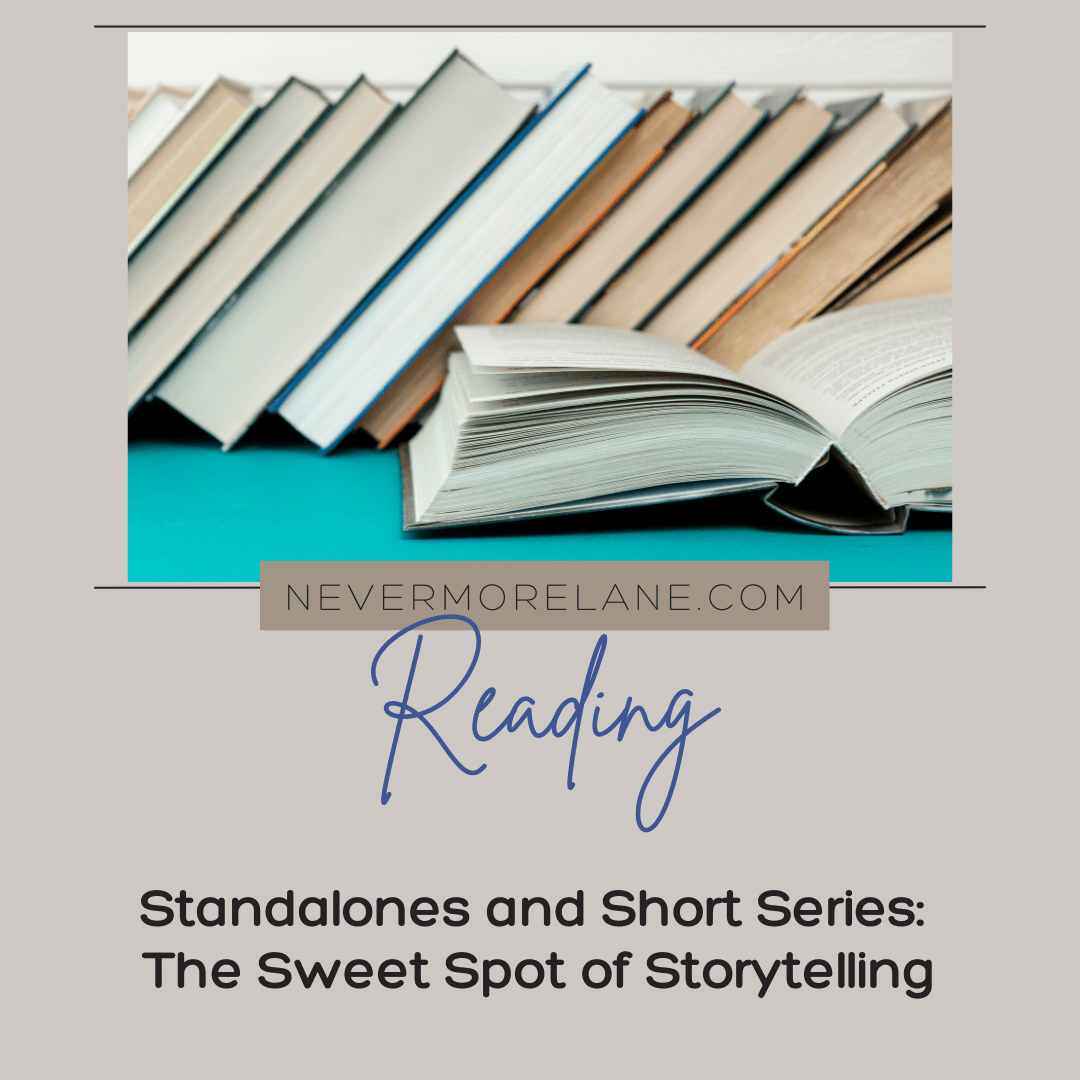
There is a particular kind of grief that arrives at the end of a perfect book. The story closes, the characters release you, and you stand blinking in the doorway between that world and your own, a little changed by where you have been. It is bittersweet and complete. It feels, in the oldest sense of the word, finished. That feeling has become rarer than it should be.
If you have found yourself staring at a towering stack of unread series installments and feeling something closer to obligation than joy, you are not alone. Readers everywhere are having the same quiet reckoning: somewhere between book three and book seven of a story that was originally sold as a trilogy, something shifted. The magic thinned. The pages kept coming but the feeling of forward motion did not. What began as a love affair with a fictional world started to feel like a contract you did not fully remember signing.
The good news is that the antidote already exists and it has been waiting patiently on the shelf this whole time. Standalone novels and well-crafted short series are not consolation prizes for readers who cannot commit to the long haul. They are, in many ways, the most sophisticated storytelling form available, built on intention and constraint and the radical promise of a real ending. If you are ready to fall in love with books again, this is where to start.
How Publishing Fell in Love With the Endless Series
To understand why readers are burned out, it helps to understand the machinery behind what they are reading. Publishing is a business, and series are reliably good business. A reader who falls in love with a protagonist in book one is statistically likely to return for book two, book three, and beyond. Backlist compounds over time. Marketing for a new installment lifts sales across the entire catalog. The author’s name becomes a brand, and the brand’s implicit promise is simply: more.
None of this is inherently cynical. Some stories genuinely need space to breathe across multiple volumes. World-building of real depth and complexity takes time. Characters whose arcs span years of in-world experience cannot always be contained within a single book without being diminished. Long series exist because long series, at their best, offer something no standalone can: the accumulated weight of time spent inside a world that keeps expanding.
But incentive structures have a way of rewarding length regardless of whether length serves the story. And so the publishing landscape has become dense with trilogies that were really duologies, five-book epics that peaked at book two, and ongoing series where the central conflict has been carefully managed to remain unresolved because resolution would signal the end of revenue. Readers did not create this pattern. The pattern was built for them, and they are only now starting to push back.
What Series Fatigue Is Really Costing Readers
Series fatigue is not simply about disliking sequels. It is something more precise and more corrosive: the creeping suspicion that you are being deliberately strung along. That the questions raised in book one were not planted with authorial care but manufactured to make book two feel necessary. That the romantic tension will not resolve, the central mystery will not fully close, the world will not settle into itself, because completion would end the commercial arrangement the series depends on.
It looks like a shelf crowded with books you have not finished and feel vaguely guilty about. It feels like hesitation at the start of a new book once you realize it is labeled book one of an unspecified number of installments. It sounds like the negotiation readers have with themselves before committing: do I trust this author to actually end this story? It manifests as a kind of reader’s paralysis that keeps even enthusiastic, committed readers from starting things they might genuinely love.
The cost is not only to individual reading lives. It is to the relationship between readers and stories itself. Reading is, at its most fundamental, an act of trust. You give a story your time, your attention, your willingness to be moved. In exchange, the story promises to take you somewhere worth going and to bring you back changed. When a series violates that trust by refusing to complete its own arc, the breach is not forgotten quickly. Readers who have been burned often respond by narrowing their range, returning only to authors they already know, or gravitating toward shorter forms where the risk of abandonment feels lower.
Why Standalone Novels Are a More Demanding Art Form
A standalone novel operates under a constraint that is both limiting and deeply generative: it must complete itself. There is no sequel to absorb the overflow, no follow-up book to explain what the first one left unresolved. Every element introduced must be purposeful. Every thread pulled must eventually land somewhere. The ending must earn the beginning, and it must do so within the pages the reader is already holding.
This is not easier than writing a series. In many respects it is harder. A sprawling series can afford to develop slowly, to let subplots unfurl over years of publication, to introduce characters who do not pay off their initial promise until book four. A standalone has no such latitude. The writer must make meaningful decisions about what belongs in the story and what does not, and those decisions must all be made in service of a single coherent whole. The result, when a writer pulls it off, is a kind of reading experience that feels almost architectural: every part supporting every other part, nothing wasted, everything purposeful.
The best standalones feel inevitable in retrospect. You finish them and think: of course it ended there. Of course that was where the story was always going. That feeling of rightness is not accidental. It is the product of a writer who knew what they were building before they started and who held the shape of the whole story in mind through every chapter. The satisfaction of that ending lands differently from a cliffhanger engineered to sell the next installment. It is the difference between a meal that leaves you comfortably full and a meal interrupted before the final course arrives.
The standalone’s constraint also produces a particular kind of character work. When a character cannot simply continue growing across seven books, every scene of transformation must carry more weight. Decisions have consequences that play out within the same volume. The reader experiences the full arc of a life or a crisis or a journey, held in their hands all at once, complete.
The Short Series as an Architecture of Intention
There is a distinction worth making carefully between a series that was planned and a series that was extended. A two- or three-book arc conceived from the beginning as a complete story is an entirely different reading experience from a series that kept going because the first book sold well enough to justify a second contract and then a third and then somehow a seventh.
Planned short series have a shape that readers can feel even without knowing the author’s intentions. The second book deepens the world without simply retreading it. The third closes threads that the first book wove so quietly you may have forgotten they were there. The story expands because the narrative requires expansion, not because the contract demands more pages. These are the series readers return to and reread, not because they never ended but because when they ended, they felt whole.
The architecture of a well-conceived short series is its own sophisticated art form. It requires a writer willing to let the first book do quiet work that does not pay off until the third. It asks readers to sit with unresolved tension long enough for it to mean something when it resolves. It demands that each installment function as a satisfying reading experience on its own while also contributing to something larger. Getting that balance right is genuinely difficult, and when it is achieved, readers know it. Book one is transformed by reading book three. The ending is not just satisfying: it is retroactively illuminating.
The short series also asks something of publishers: the willingness to let a story end. Not every successful two-book story needs a third installment. Not every beloved trilogy needs to be expanded into a universe. The short series that ends as planned, even if readers wish it would continue, has done something that extended series rarely manage. It has made readers want more while still giving them something complete. That wanting is a gift, not a failure. It means the story worked.
How Readers Are Already Reshaping the Market
The conversation about series fatigue is not happening only in quiet corners of the internet. It is visible in reading communities, in the patterns of what books are being talked about and shared, in the way readers rate and review ongoing series versus standalones and completed short series. Readers are increasingly vocal about a preference for stories that respect their time and their investment. They are seeking out authors known for finishing what they start. They are treating a satisfying conclusion as a selling point rather than a baseline expectation.
This is not a rejection of serialized storytelling. It is a recalibration, and it is worth naming clearly. Readers are not asking for less story. They are asking for a story that knows what it is doing and where it is going. They are asking for the writers and publishers behind their favorite books to treat the ending as something worth crafting, not something to be deferred indefinitely in the service of an open-ended commercial relationship.
Genre spaces, which have historically been the most comfortable territory for very long series, are also beginning to shift. Readers in romance, mystery, fantasy, and literary fiction alike are expressing a growing appetite for contained arcs, for books that can be recommended without the caveat that the series is not finished yet, for stories where investment does not require a decade of patience. The standalone and the planned short series are not nostalgia for a simpler time. They are an answer to a question readers are actively asking right now.
What a Complete Story Actually Does for a Reader
There is something deeply human about wanting stories that end, and it is worth saying plainly. Not because endings are easy or because resolution is always clean but because completion is part of what stories are for. We read, in part, to experience the shape of things: a beginning that raises a question, a middle that complicates it, an ending that answers or transforms it. The arc resolving. The characters landing somewhere. The world of the book clicking into its final form and releasing us back into our own.
When a story refuses to end, it cannot do that work. It becomes something else instead: a world to visit indefinitely, a comfort, a habit. That has value. But it is not the same as what a finished story offers, which is the particular quiet satisfaction of a tale told all the way through. The feeling of being held by something that knew where it was going and took you there with intention. The closure that allows you to carry the story forward as a complete thing rather than an ongoing obligation.
That feeling is still available. It lives in standalones and in series that were planned with endings in mind from the first page. It requires writers who are willing to finish what they start and publishers willing to let them. It requires readers willing to seek it out and to say, loudly and consistently, that this is what they value.
The sweet spot of storytelling is not a word count or a volume count. It is intention. It is the story that is exactly as long as it needs to be, no longer and no shorter, ending when the ending is earned rather than when the contract runs out. That story is worth looking for. It is worth asking for. And when you find it, it is worth staying up late for.
The Stories That Stay With You Are the Ones That Ended
The books that live longest in us are rarely the ones that never finish. They are the standalones we pressed into the hands of people we loved with the words: read this, it will change you. They are the trilogies we finished in a long weekend and then sat quietly with for an hour afterward, not ready to let them go. They are the short series we reread years later and found, to our delight, that they had grown richer in memory rather than thinner.
These books earned their place in us by completing their own promise. They were built by writers who knew what they were making and saw it through to its right ending. They were released by publishers willing to trust that a finished story is not the end of a commercial relationship but the beginning of a reader’s lifelong attachment to an author.
If you are ready to fill your shelf with books that will stay with you, start with the ones that end. Start with the standalones that make the whole story a gift. Start with the short series where each book makes the last one better. Start, most of all, with writers who trust you enough to actually finish the story they promised. They are out there, and they are writing some of the best books available right now.
When you find them, come tell me about them. I will have the kettle on.
If this resonated, you might also love browsing the reading life posts here at Nevermore Lane. There is always something brewing in the archive for readers who take their books and their slow mornings seriously. And if you would like to sit with me a little longer, come join me for coffee. Pull up a chair, get comfortable, and let us talk about the books that stayed with us.
Like what you read? Drop me a line – let’s chat over virtual coffee.
~ Chrystal