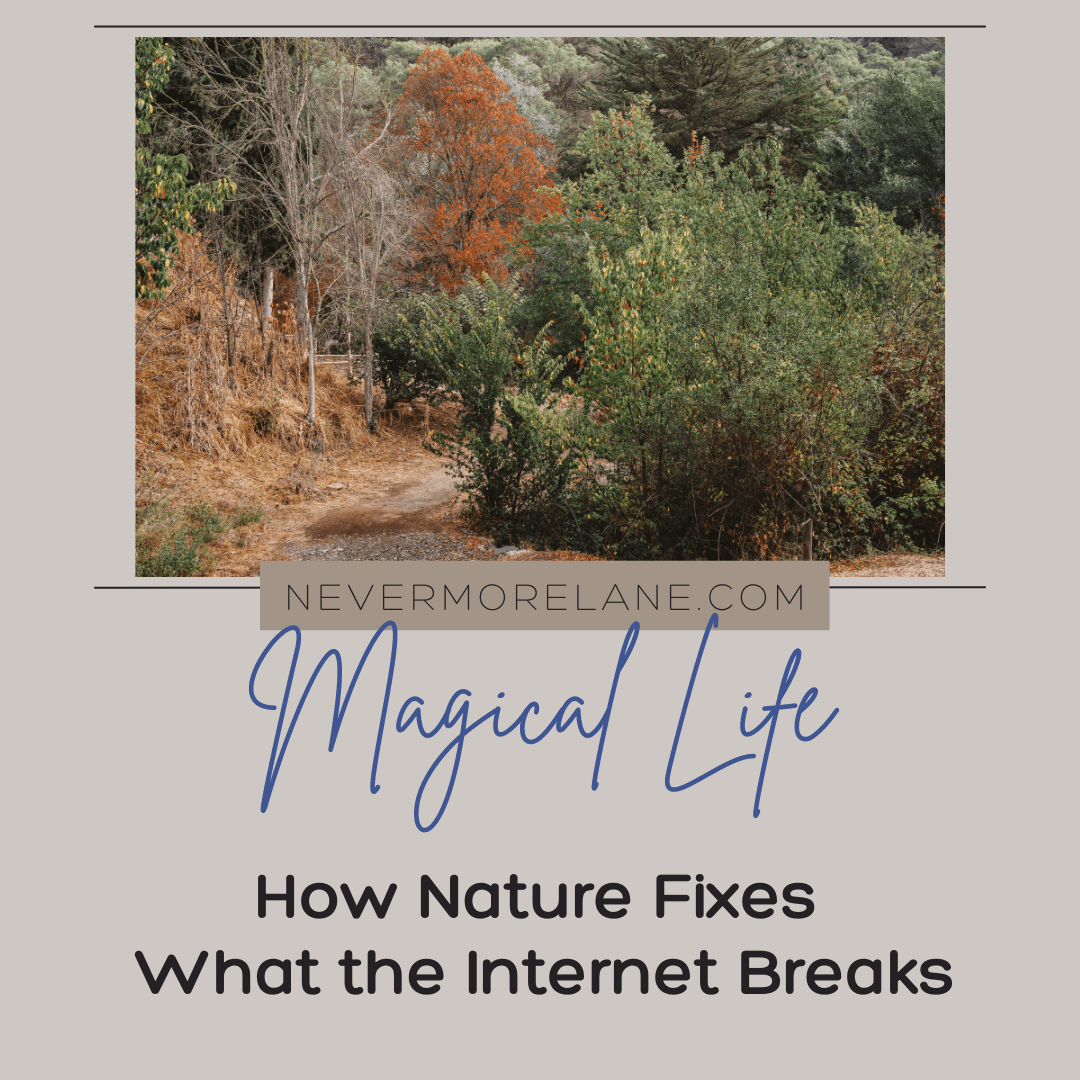
How Nature Fixes What the Internet Breaks
There is a particular kind of tired that has no name in the old books. It is not the tiredness that comes from a long day of physical work, the satisfying ache of a body well used. It is not even the gentle heaviness of a late night spent reading by lamplight. This tiredness lives behind your eyes. It hums in your jaw. It makes you reach for your phone before you have fully decided to, the way you might scratch an itch you did not feel until the scratching had already started. If you have felt it, you know exactly what I mean.
I have been spending a lot of time thinking about what the internet does to a person, not in the grand political sense, but in the small bodily sense. What it does to your nervous system when you are never fully away from it. What it costs you, hour by hour, to live so much of your life in a space that is engineered to keep you slightly agitated and always wanting more. I have noticed it in myself on the days when I finally close the laptop and step outside, and something in me exhales that I did not know was being held. The contrast is impossible to ignore once you have felt it enough times.
That exhale is not a coincidence. It is not simply a break from a screen. Something real and measurable happens in the body when it encounters the living world, and for those of us drawn to earth magic and intentional living, it is worth understanding more than casually. Nature does not just offer a pleasant backdrop for slowing down. It actively repairs what digital life erodes. This post is about how that works, and how to let it.
Why Digital Life Leaves You Depleted and Overstimulated
Modern internet life is, at its structural core, a relentless novelty machine. Every scroll produces something new. Every refresh resets the reward cycle. Your brain, which evolved over millennia to respond to change and movement as signals of potential threat or opportunity, cannot fully distinguish between a rustling in the tall grass and a new notification. Both light up the same ancient circuitry. The difference is that the tall grass eventually goes still. The notifications never do.
This is not a moral failing or a lack of willpower. It is a nervous system responding as designed to an environment it was never designed for. The term researchers use is cognitive overload, but the lived experience is more like a static you cannot turn off. Your attention fractures. Your capacity for sustained thought shrinks. You find yourself rereading the same paragraph, or sitting down to do one thing and somehow doing three other things instead. The internet does not just consume your time. It reshapes the instrument you use to experience your life.
What makes this particularly insidious for those of us who love slow living and intentional presence is that the damage is cumulative and subtle. You do not feel it happening in the moment. You only notice it in the gap between who you meant to be today and who you actually were. The shortened patience. The inability to sit quietly without filling the silence. The way a whole afternoon can pass and feel like it contained almost nothing. Digital depletion does not announce itself. It just quietly shrinks your world.
How Time Outdoors Restores Attention and Calm
The research on nature and attention restoration is substantial enough now that it has its own theoretical framework. Attention Restoration Theory, developed by Rachel and Stephen Kaplan in the 1980s, proposes that natural environments are uniquely suited to replenishing directed attention, the focused, effortful kind you use when you are working, making decisions, or trying to concentrate. Natural settings do this by engaging what the Kaplans call fascination, an effortless, gentle form of attention that does not tax the system the way screens do.
When you walk through trees, or watch light move across water, or simply sit near something green and growing, your brain shifts modes. The effortful vigilance that digital life requires begins to quiet. You are still taking things in, but the quality of that attention is fundamentally different. It is receptive rather than reactive. It restores rather than depletes. Studies measuring this effect have found that even relatively short exposures to natural settings, as little as twenty minutes, produce measurable reductions in cortisol and improvements in focus and mood.
For those of us who practice any form of earth magic or nature-based spirituality, this is something we have known in the body long before the studies confirmed it. Standing barefoot on actual ground, watching the birds sort themselves into the feeder outside your window, pressing your hands against the bark of a tree that has been standing longer than your grandmother was alive. These are not decorative experiences. They are regulating ones. Your nervous system is calibrated to the living world. When you return to it, something essential comes back online.
The Grounding Effect of Natural Sensory Experience
One of the things the internet most thoroughly disrupts is your relationship with your own senses. Digital life is overwhelmingly visual and auditory, but even those senses are engaged in a narrow, artificial way, filtered through glass, flattened onto screens, stripped of dimension and texture and smell. You can spend an entire day receiving enormous amounts of information and emerge from it feeling strangely hollow, because your body was barely involved in any of it.
Nature corrects this through sheer sensory richness. The temperature of moving air on your skin. The specific smell of soil after rain, which comes from a compound called geosmin and which humans can detect at concentrations as low as five parts per trillion, evidence of how deeply this sensory channel runs in us. The sound of wind in leaves, which research suggests activates the parasympathetic nervous system in ways that slow heart rate and breathing. These are not small pleasures. They are biological recalibrations. Your body was built to receive this kind of input, and it responds to it at a cellular level.
There is also something worth naming about the way natural sensory experience pulls you into the present tense. A screen can show you a thousand things from a thousand places and times. A cold stone in your hand is only ever right here, right now. This is part of why nature practices show up across so many spiritual traditions as a path to presence. Not because nature is mystical in a vague, abstract sense, but because it is so thoroughly, insistently real. It asks nothing of your future self and nothing of your past. It only asks you to be here, which is the one thing the internet almost never does.
Simple Nature Practices for the Digitally Depleted
You do not need a forest or a coastline to access what nature offers, though those are gifts worth seeking when you can. What you need is intention and a willingness to let the natural world actually land on you rather than moving past it on your way to the next thing. Start small and specific. Choose one window in your home and commit to sitting near it for ten minutes each morning without your phone. Watch what is happening outside. Let your eyes adjust to natural light and natural movement rather than artificial ones.
If you have any outdoor space at all, even a small one, use it differently than you have been. Not to accomplish something, but to simply be in it. Bring your tea outside and drink it slowly. Sit on the ground if you can. Notice what is growing near you, what is visiting, what the sky is doing. These are not passive or lazy practices. They are active repairs to a nervous system that has been running on too much stimulation for too long. The magic traditions have always known that the earth has something to offer the weary, and that offer is not metaphorical.
For those days when getting outside feels impossible, bring nature in wherever you can. A bowl of stones from somewhere that mattered to you. A living plant you actually tend. The sound of rain or birdsong played softly in the background while you work. Fresh herbs on your windowsill that you touch and smell when you pass. None of these replace the real thing, but they are genuine signals to your nervous system that the living world is nearby, and they do something. Ritual, in the earth magic sense, is often simply a structured way of directing your attention toward what restores you. Nature practices are no different.
Returning to the Living World as a Radical Act of Care
There is a quiet radicalism in choosing the living world over the digital one, even briefly and imperfectly. In a culture that treats your attention as a resource to be extracted, stepping outside and giving that attention to the sky costs no one anything and returns something to you. It is one of the few places left where nothing is trying to monetize your gaze. The birds do not need your engagement metrics. The moss does not have an agenda. This is rarer than it sounds, and it is worth protecting.
What I keep coming back to is that this is not a rejection of technology or an argument for going fully off-grid. It is an argument for honoring the body you actually live in, which is an animal body, which is ancient, which was shaped by the living world and still responds to it with recognition and relief. You can love your books and your laptop and your online communities and still need the particular medicine that only the nondigital world provides. These things are not in competition. They are in balance, when we let them be.
The invitation here is a gentle one. Not to overhaul your life or commit to an ambitious nature routine. Simply to notice where the digital world has been taking more than it gives, and to meet that depletion with something older and quieter than a screen. Step outside when you can. Sit near something living. Let your eyes rest on a horizon or a canopy or even a single weed pushing up through a sidewalk crack with unreasonable determination. The earth has been doing this longer than the internet has existed, and it is very, very good at it.
Let the Living World Have You Back
The internet will always be there when you return. The notifications will wait. But the quality of the light at this particular hour, the temperature of this specific afternoon, the particular mood of the sky outside your window right now, those are only happening once. That is not a reason for anxiety. It is an invitation to presence.
If something in this post stirred something in you, I would love for you to keep reading. Nevermore Lane is full of ideas about slow living, earth magic, and the art of building a life that feels genuinely inhabitable. Spend some time here. Follow a thread that interests you and see where it leads.
And if you want to talk about any of it, come find me. I am always up for a slow cup of coffee and a good conversation about the things that matter quietly. Pull up a chair.
Like what you read? Drop me a line – let’s chat over virtual coffee.
~ Chrystal