A Clear Guide to Planning Full-Arch Tooth Replacement
Post Preview
Key Takeaways
- Full-arch tooth replacement is a significant health decision that requires careful diagnosis and planning.
- The best option depends on oral health, bone support, medical history, daily habits, budget, and personal goals.
- Patients should understand treatment stages, recovery needs, maintenance, risks, and all expected costs before agreeing to care.
- Regular cleaning and follow-up visits remain essential after treatment is complete.
Why Careful Planning Matters
Loose teeth, painful chewing, repeated repairs, poorly fitting dentures, and difficulty speaking can all lead someone to consider full-arch tooth replacement. Although appearance may be part of the decision, a successful plan must also address bite balance, gum health, bone support, comfort, access for cleaning, and long-term function.
For people researching all on X implants, it is helpful to remember that no single approach fits every patient. A treatment recommendation should follow a complete examination and a discussion of alternatives, rather than a decision based solely on speed, marketing language, or a headline price.
What Full-Arch Tooth Replacement Means
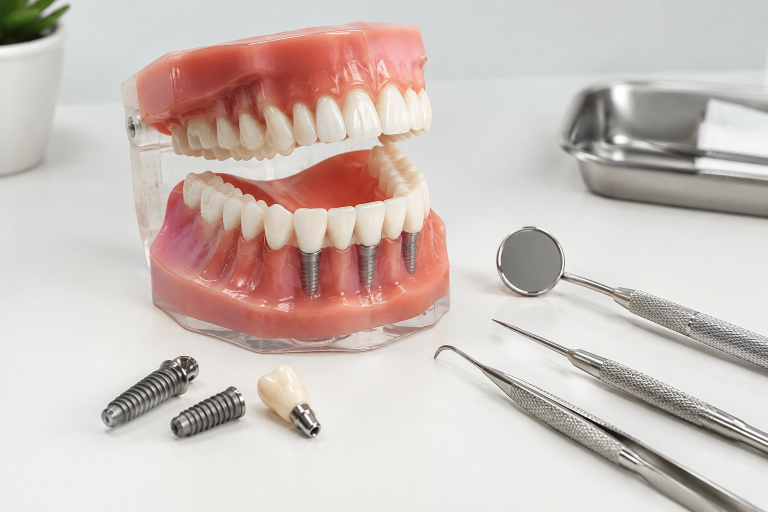
Full-arch tooth replacement refers to treatment that replaces most or all teeth in the upper or lower jaw with a single connected restoration. Depending on the situation, the restoration may be a traditional removable denture, a removable restoration secured by implants, or a fixed restoration supported by implants.
Some plans involve removing failing teeth, treating gum infection, preparing the jaw, placing implants, wearing temporary teeth, and returning later for a final restoration. Others may use a more conservative approach when remaining teeth have a good long-term outlook.
Who May Need to Consider It?
A dentist may discuss full-arch treatment when several teeth cannot be restored predictably, decay or gum disease is extensive, teeth are loose or fractured, or an existing denture creates persistent problems with fit and chewing. Major tooth loss can also affect speech, food choices, and day-to-day confidence.
Missing teeth alone do not determine whether full-arch treatment is appropriate. Preserving healthy, stable teeth is often an important consideration. The American Dental Association notes that patients should receive a comprehensive examination and discuss the range of options available before moving forward with complex implant care.
Health Checks Before Treatment
Planning begins with a review of oral and overall health. The dental team may assess the gums, bite, remaining teeth, existing dental work, hygiene habits, tobacco use, medical conditions, and medications. Patients should provide a complete medication list, including prescriptions that may affect bleeding, healing, bone metabolism, or infection risk.
Records may include an oral and periodontal examination, dental X-rays, digital scans or impressions, and three-dimensional imaging when more detail about bone and nearby anatomy is needed. Medical coordination may also be appropriate when a health condition could affect surgery or recovery.
Fixed and Removable Choices
Comparing options means looking beyond whether replacement teeth can be removed at home.
- Traditional dentures: These are removable and may require less invasive treatment. Ask how retention, sore spots, speech, and chewing will be managed.
- Implant-supported removable restorations: These are designed for added stability yet can still be removed for cleaning. Ask how attachments will be serviced and how often adjustments may be needed.
- Fixed full-arch restorations: These are attached to implants and removed by a dental professional when necessary. Ask how the areas beneath the restoration will be cleaned at home.
More complex treatment is not automatically better. A practical choice should fit the patient’s anatomy, health, comfort preferences, ability to clean the restoration, and financial circumstances.
Bone and Gum Health Questions
Active gum disease and infection can affect treatment planning. The care team should explain whether the infection needs to be addressed before surgery, whether enough bone is available for the proposed plan, and whether grafting or staged treatment may be considered.
Patients should also ask how gum contours may change during healing and whether the final design leaves enough space for daily cleaning. Implant-supported restorations need ongoing care because the gums and supporting bone remain vulnerable to inflammation.
Building a Realistic Timeline
Full-arch care commonly unfolds in stages: consultation and imaging, discussion of alternatives, treatment of infection or damaged teeth, surgery when appropriate, temporary restoration, healing visits, final restoration design, and long-term maintenance. Healing and laboratory timelines vary, so patients should be wary of promises that every case will be completed on an identical schedule.
Comfort, Recovery, and Warning Signs
Before treatment, ask about anesthesia or sedation options, expected discomfort, food restrictions, work and exercise limits, sleep guidance, and after-hours contact information. Written instructions can make the first days of recovery easier to manage.
The FDA explains that dental implants are surgically placed medical devices and that overall health, smoking, hygiene, and regular follow-up can affect healing and long-term outcomes. Its guidance on potential benefits and risks of dental implants also advises patients to report a loose or painful implant promptly.
Contact the dental provider promptly for any of the following: increased pain after the early recovery period, new or worsening swelling, fever, drainage, a loose restoration, a sudden change in bite, or persistent numbness. Difficulty breathing or swallowing requires urgent medical attention.
Costs, Estimates, and Provider Comparisons
A complete estimate should clarify what is included, such as exams, imaging, extractions, temporary teeth, surgery, sedation, laboratory work, follow-up visits, repairs, and maintenance. Ask what may incur extra costs if the plan changes, and whether financing terms are separate from clinical recommendations.
When comparing providers, ask who performs each stage, how the plan is documented, what happens if complications occur, and who will provide long-term follow-up. A second opinion can be especially useful before irreversible treatment, particularly if healthy teeth may be removed.
Daily Care and Final Checklist
Replacement teeth still require daily care. Brush the restoration and gumline as directed, clean beneath any connected restorations with the recommended tools, attend maintenance visits, and report any bleeding, swelling, bad taste, looseness, or changes in your bite. Avoid using the restoration to bite hard objects or open packages.
Before saying yes, confirm that you have received a complete examination, written treatment sequence, clear explanation of alternatives and risks, itemized estimate, recovery instructions, and a realistic cleaning and follow-up plan. Thoughtful planning gives full-arch tooth replacement the best chance of supporting comfort, function, and confidence over time.